Moving to Spain: getting your belongings through customs
The rules for bringing household goods into Spain duty-free from outside the EU, the papers brokers ask for, and why the inventory should be in Spanish.
 The BoxTrack team · · 5 min read
The visa came through in August. The apartment in Valencia is rented from November, the house in Ohio is under contract, and the international mover has emailed a document checklist with one line that stops you cold: "Valued inventory, in Spanish, signed by the shipper."
Spain, like the rest of the EU, lets people who are moving their home there from outside the EU bring their household goods in without paying import duty or VAT. It's a real saving on a full container, but it's a relief you claim, with conditions, and the paperwork is where moves get held up. Here's what the rules say and how to get ready.
The rules for duty-free import
Spain's tax and customs agency, the Agencia Tributaria, applies the EU rules on transfer of residence. In plain terms:
You lived outside the EU for at least 12 consecutive months before the move. This applies to Spanish citizens coming home as much as to anyone else.
The things are yours and you've had them a while. Your personal property must have been in your possession and used at your old home for at least six months before the move. Some goods, vehicles among them, have their own conditions, so check those separately if you're shipping a car.
They're for your own use in Spain. Household goods brought in this way can't be for resale.
You import them in time. Goods have to be declared within 12 months of setting up your residence in Spain. You can also ship before you move, as long as you commit to establishing your residence within six months.
You keep them for a year. For 12 months after the goods are cleared, you can't lend, pledge, rent out or transfer them, paid or free, without telling customs first.
Some things don't count as household goods under the EU rules, wherever they're from: alcohol, tobacco and tobacco products, commercial vehicles, and equipment for your trade or business (other than portable instruments of the applied or liberal arts). Those go through customs under the normal rules, with duty.
The Canary Islands are different. They're in the EU customs territory but outside the EU VAT area, and they have their own local tax (IGIC). If you're moving to the Canaries, ask your mover for its Canary Islands requirements; they won't be the same as for the mainland.
The papers your mover will ask for
Your international mover or its customs agent in Spain files the declaration. What they ask you for varies a little, but expect most of this:
- a copy of your passport
- proof you lived outside the EU for the last 12 months. For Spanish citizens, that's usually the certificate of consular registration and deregistration (the baja consular) from the consulate where you were registered. For non-EU citizens, brokers ask for official proof such as a certificate from your town or consulate, sometimes backed by tax returns from your country of residence.
- proof you're settling in Spain, such as your visa, residence card or work contract
- a valued inventory in Spanish, signed by you
- the bill of lading or air waybill, which the mover provides
Ask for the exact list early. Some documents, like official certificates from abroad, can take weeks, and a few brokers want them translated or apostilled.
The inventory is the part you control
Brokers ask for the inventory in Spanish, with values, signed by you. Customs uses it to check that what's in the shipment matches what you've declared. A vague list ("35 boxes, personal effects") is the kind that gets questions.
A good one:
- numbers every box, with the same numbers written on the boxes
- lists the contents of each box specifically: libros (30), lámpara de escritorio, impresora (books, desk lamp, printer), not oficina
- puts a value on each box or item. Used household goods aren't worth their new price, so use a fair used value
- flags anything that looks new. A laptop or a TV bought last month doesn't meet the six-month rule
- leaves out what isn't shipping. If you're selling the couch or storing the bikes, keep them off the list
Translating it is easier than it sounds if your list is specific; brokers expect plain item names, not perfect Spanish. Build the list as you pack, not the night before pickup.
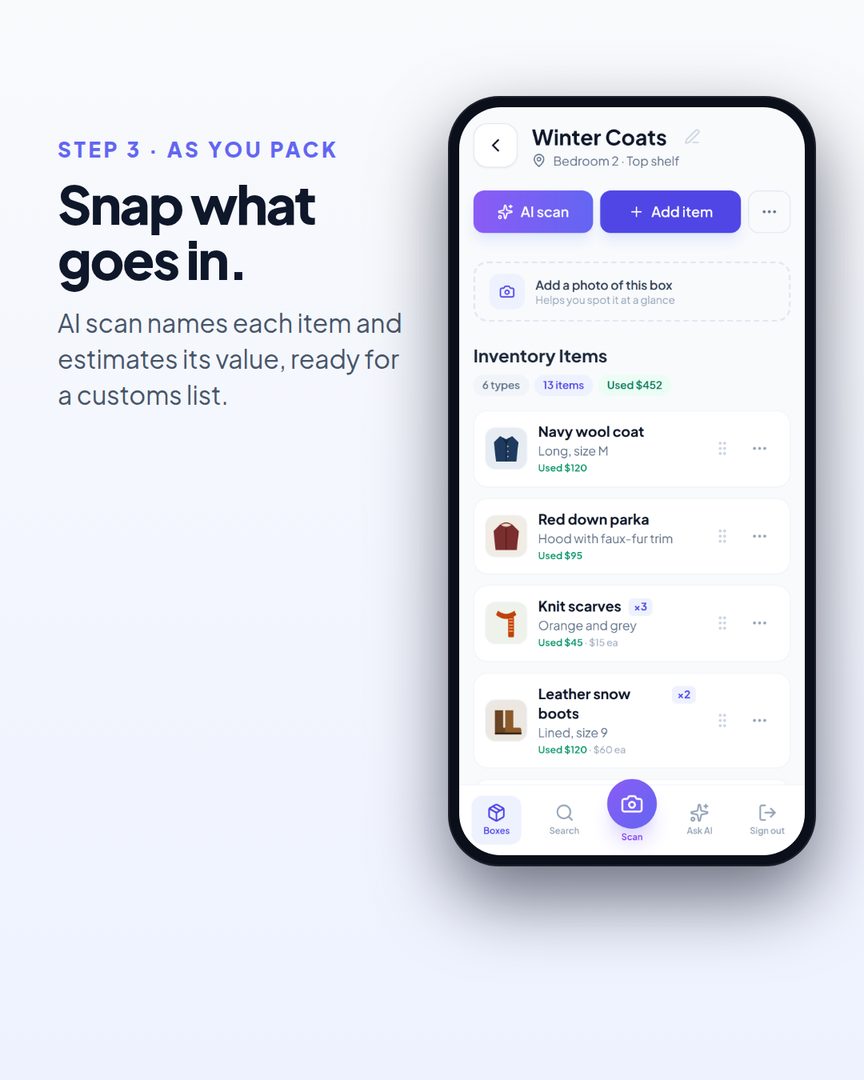
BoxTrack is built for this part. Give each box a QR label, snap a photo of what goes in, and the item list fills in with an estimated used value for each item. Tag anything you're selling or storing, then export the shipping boxes to Excel: box numbers, items, quantities and values, ready to translate and sign. Your first box is free. (Our moving abroad packing list has more on what goes in a customs inventory.)
A few things to sort out before you pack
- Wine and spirits: not covered by the relief. Drink them, give them away, or expect to pay.
- Medicines: bring a doctor's letter and keep prescriptions in their original packaging. Ask about anything controlled before you ship it.
- Pets travel under EU pet rules (microchip, rabies vaccination, and an animal health certificate for pets coming from outside the EU). Start with your vet early.
- A car is its own project: customs, then Spanish registration and inspection. Get advice before you decide to ship one.
- Food: EU rules limit meat, dairy and many plant products. Leave the pantry behind.
A short timeline
- 3 months out: get quotes from at least two international movers and ask each for its Spain customs checklist. Start any certificates you need from your local or consular offices.
- 6-8 weeks out: pack what you won't need, building the inventory box by box.
- 2-3 weeks out: translate the inventory, add values, and send the full set of papers to the mover.
- Pickup day: check the mover's box count against yours, and keep copies of everything you signed.
- In Spain: stay reachable. The customs agent may need a signature or a missing document before your goods are released.
Coming the other way some day? See our guide to moving back to the US with your household goods.
Sources
- Agencia Tributaria, Transfer of residence: duty and tax exemptions
- Ministerio de Asuntos Exteriores, Regresar a España (baja consular and returning residents)
- EU Council Regulation (EC) No 1186/2009, relief from customs duty (Title II, personal property)
This is general information, not legal or customs advice. Rules and requirements change, and your situation may differ; check with the Agencia Tributaria or your mover's customs agent in Spain before you ship.