Moving abroad: the packing list customs will ask for
What goes on a customs inventory, how the UK and Canada describe it, and how to build the list as you pack instead of the night before.
When you ship household goods to another country, two groups of people will ask what's in your boxes: your international mover, and the customs authority at the other end. Both usually want an itemized list of what you're shipping, often with values. If the list is vague ("kitchen stuff, 12 boxes"), expect questions, delays, or an inspection that opens the boxes for you.
This guide explains what a customs-ready packing list usually includes, shows how two common destinations describe it, and gives you a workflow for building the list while you pack instead of the night before the movers arrive.
Customs rules differ by country and change over time. Always check your destination's official customs website and ask your international mover for their exact list format before you pack.
What a customs packing list usually includes
Formats vary, but most lists ask for the same things:
- Box or item number, matching a number written on the box.
- Description of the contents: specific enough to understand ("men's winter coats, 3"), not "clothes."
- Quantity of each item.
- Value: often the current used value, sometimes the replacement value. Your mover or the destination's guidance will tell you which.
- Make, model and serial number for electronics, appliances, and anything high-value.
- Whether the item is new or used, and sometimes how long you've owned it.
- A split between what travels with you and what arrives later, in some countries.
The list is usually signed by you and submitted alongside your passport, visa or residence documents, and the shipping paperwork.
Example: moving to the UK
The UK offers Transfer of Residence (ToR) relief, which can let you bring personal belongings into the UK without paying import duty or VAT if you meet the conditions. According to GOV.UK, you generally need to have lived outside the UK for at least 12 consecutive months, have owned and used the goods for at least 6 months before moving, and import them within 12 months of moving. You apply with the ToR1 form and include details of the goods you're bringing. Items brought in under the relief generally can't be sold, lent or given away for 12 months.
In practice, that means your inventory (with descriptions and values) is part of the application.
Example: moving to Canada
Canada calls household goods brought by a new resident settlers' effects. The Canada Border Services Agency's guidance on moving to Canada and Memorandum D2-2-1 describe preparing a detailed list in duplicate of the goods you're importing, with make, model, serial number where possible, and approximate value, split into:
- goods that come with you when you arrive, and
- goods to follow, which arrive later in a shipment.
You declare the goods to follow when you arrive. If they aren't on the list, you may lose the duty-free treatment for them. The form used is the BSF186 Personal Effects Accounting Document.
How to build the list while you pack
The worst time to write a customs list is after the boxes are sealed. Here is a workflow that keeps the list accurate without slowing you down.
1. Number boxes before you fill them
Write or stick a number on each box before anything goes in. That number links the physical box to its line on your list. A QR label does the same job and lets anyone scan the box to see the contents.
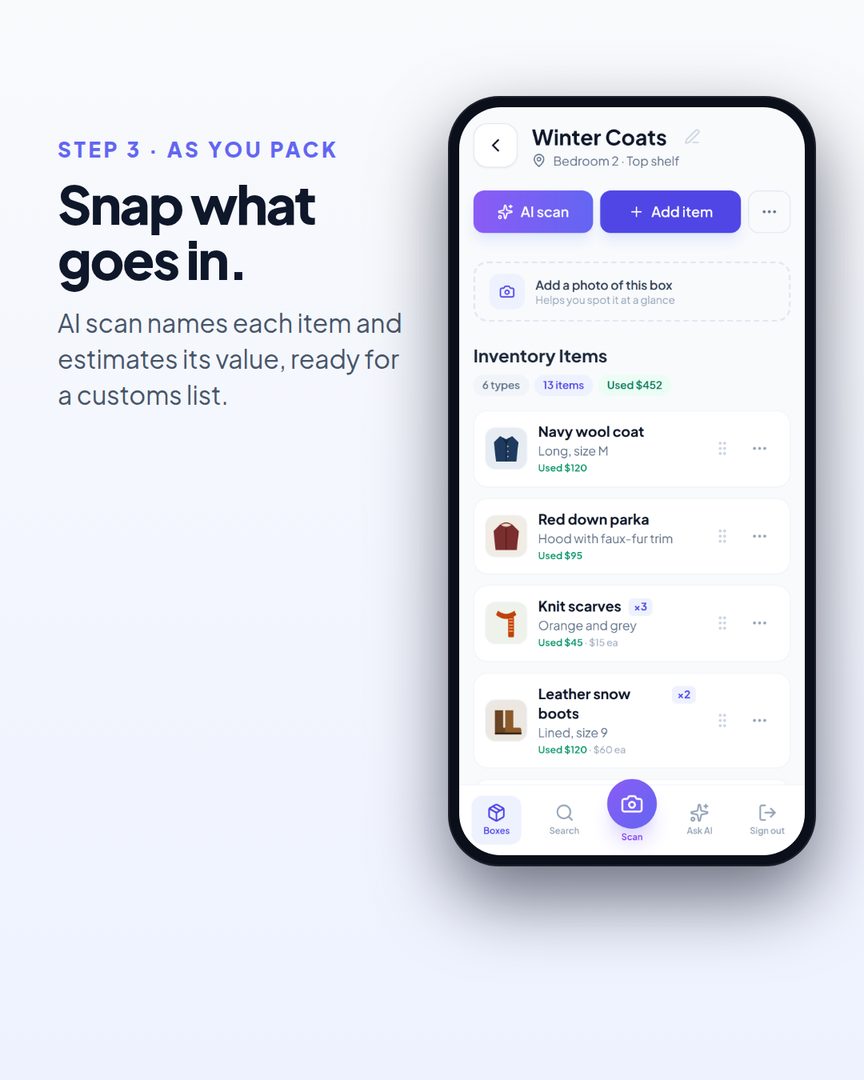
2. List items as they go in
For each box, record the items as you pack them. Be specific about anything a customs officer might care about: electronics, alcohol, food, medicines, plants, wood, tools, sporting goods. For low-value groups, a count is usually enough ("children's books, 30").
3. Add values as you go
Decide early whether your list needs used value, replacement value, or both. Estimate as you pack; it's much harder to remember what a box held later.
4. Photograph high-value items and serial numbers
A photo of the item and its serial-number sticker helps with customs questions and with insurance claims if something is damaged in transit.
5. Mark what travels with you vs. what ships
If your destination separates accompanied goods from goods to follow (as Canada does), keep two lists, or a column that says which is which.
6. Export in the format your mover wants
Most movers accept a spreadsheet. If you've been listing items in BoxTrack, you can export every box and item to Excel with box numbers, quantities and values, then adjust the columns to match your mover's template.
Items that commonly cause problems
Restricted and prohibited items vary widely by country, but these categories come up often:
- Food, especially meat, dairy, fresh produce and seeds
- Plants and soil, including dirt on garden tools and outdoor furniture
- Untreated wood and wicker
- Alcohol and tobacco, which often have limits even under relocation relief
- Medications, which may need prescriptions or permits
- Weapons, including some knives and replica items
- Vehicles, which almost always have separate import rules
Check the destination's official list, and clean anything that's been outdoors (bikes, camping gear, garden tools) before packing.
Checklist
- Find your destination's official customs page for household goods
- Ask your mover for their inventory template and which value they need
- Number or QR-label every box before packing
- List items and values as each box is packed
- Photograph valuables and serial numbers
- Separate items traveling with you from items shipping later, if required
- Export the final list, sign it, and keep a copy with your travel documents
Sources
- GOV.UK, Transfer of residence to Great Britain
- GOV.UK, Moving personal belongings to the UK
- Canada Border Services Agency, Moving or returning to Canada
- Canada Border Services Agency, Memorandum D2-2-1: Settlers' Effects
- Canada Border Services Agency, Form BSF186
This article is general information, not legal or customs advice. Check with your destination's customs authority and your mover before you ship.