Food, plants and pet food across borders when you move
What happens to the spices, houseplants, jerky and dog food when you move abroad or back to the US, and what US and EU rules say about declaring them.
 The BoxTrack team · · 5 min read
The last suitcase was the "kitchen" suitcase. Three years in Lisbon, and there were things they weren't leaving behind: a tin of smoked paprika, two bags of good coffee, a jar of homemade quince paste, a wedge of cheese for the first night home, and a cutting from the fig tree on the balcony, wrapped in a damp paper towel. At the airport in Newark, the customs form asked about food, plants and soil. It was a longer conversation than they'd planned.
Food and plants are where well-meaning people moving across borders get into trouble. Most of it isn't dangerous. Some of it is banned, and nearly all of it has to be declared.
Coming into the US: declare all of it
U.S. Customs and Border Protection (CBP) is direct about this: all travelers entering the United States are required to declare meats, fruits, vegetables, plants, seeds, soil, animals and products made from them. That applies to checked bags, carry-ons and vehicles.
Declaring doesn't mean it will be taken. It means an officer decides. CBP says some fruits and vegetables can enter without advance permission depending on where they come from, if they're declared and pest-free.
Not declaring is the expensive mistake. CBP says civil penalties for failing to declare prohibited agricultural products may range up to $1,000 for a first-time offense, for non-commercial quantities.
What CBP singles out:
- Meat. CBP says many fresh, dried and some canned meats and meat byproducts are prohibited. That includes some soups and broths.
- Plants for growing. CBP says plants and plant parts intended for growing require a foreign phytosanitary certificate in advance. A fig cutting in a paper towel counts.
- Soil. CBP says no soil or earth of any kind is allowed in without a permit issued in advance. That includes the soil in a houseplant pot.
Coming into the US, per CBP
Going into the EU: meat and dairy are the big ones
The European Commission's rules on personal imports are short and strict. Travelers arriving from outside the EU are not allowed to bring in meat, milk or products made from them. That covers the cheese, the jerky and the salami.
There are narrow exceptions. The Commission says infant milk, infant food, and special foods or special pet feed needed for medical reasons are allowed in amounts up to 2 kg, if they don't need refrigeration before opening, are packaged branded products, and the packaging is unbroken unless in use. Fish is allowed up to 20 kg, and some other animal products, like honey, up to 2 kg.
So ordinary pet food made with meat or dairy doesn't fit those exceptions. Plan to buy your pet's food after you arrive, and bring just enough of a special prescription diet to bridge the gap.
Plants are tighter still. The Commission says plants, plant products and other objects can't be brought into the EU in passengers' luggage unless they have a phytosanitary certificate. That covers plants for planting, fruit, vegetables and cut flowers. The Commission exempts the fruits of pineapple, coconut, durian, banana and date.
| Item | Into the US | Into the EU |
|---|---|---|
| Meat and meat snacks | ✗ Often prohibited; declare | ✗ Not allowed |
| Cheese and dairy | Declare and ask | ✗ Not allowed |
| Fresh fruit | Declare; depends on origin | ✗ Needs a certificate, with five exceptions |
| Houseplants with soil | ✗ Soil needs a permit | ✗ Needs a certificate |
| Medical pet food, small amount | Declare and ask | ✓ Up to 2 kg, if conditions met |
The EU rules have exceptions for some nearby countries, and the US rules depend on where things come from. Check the official pages for your route.
What about the moving container?
Food in a household goods shipment is its own problem. It can spoil on a long voyage, attract pests, and slow down a customs inspection. Leaving the pantry behind is often the simplest choice.
If you do want to ship sealed, shelf-stable food, ask your mover first and list it clearly. For moves into the EU, our guides to moving to Germany and moving to Austria cover how household goods clear customs.
A simple plan for the pantry and the plants
Food and plants before a move abroad
- Six weeks outStart cooking down the pantry and freezer
- One month outFind new homes for houseplants; take photos of favorites
- Two weeks outCheck the destination's rules for anything you want to bring
- Packing dayKeep any food you're bringing in one clearly labeled box or bag
- At the borderDeclare it all; let the officer decide
Houseplants can be the hardest goodbye. Give them to friends, and take a photo of each. You can buy new ones in the new place, and you won't be explaining soil to a customs officer.
Know what's in every box before customs asks
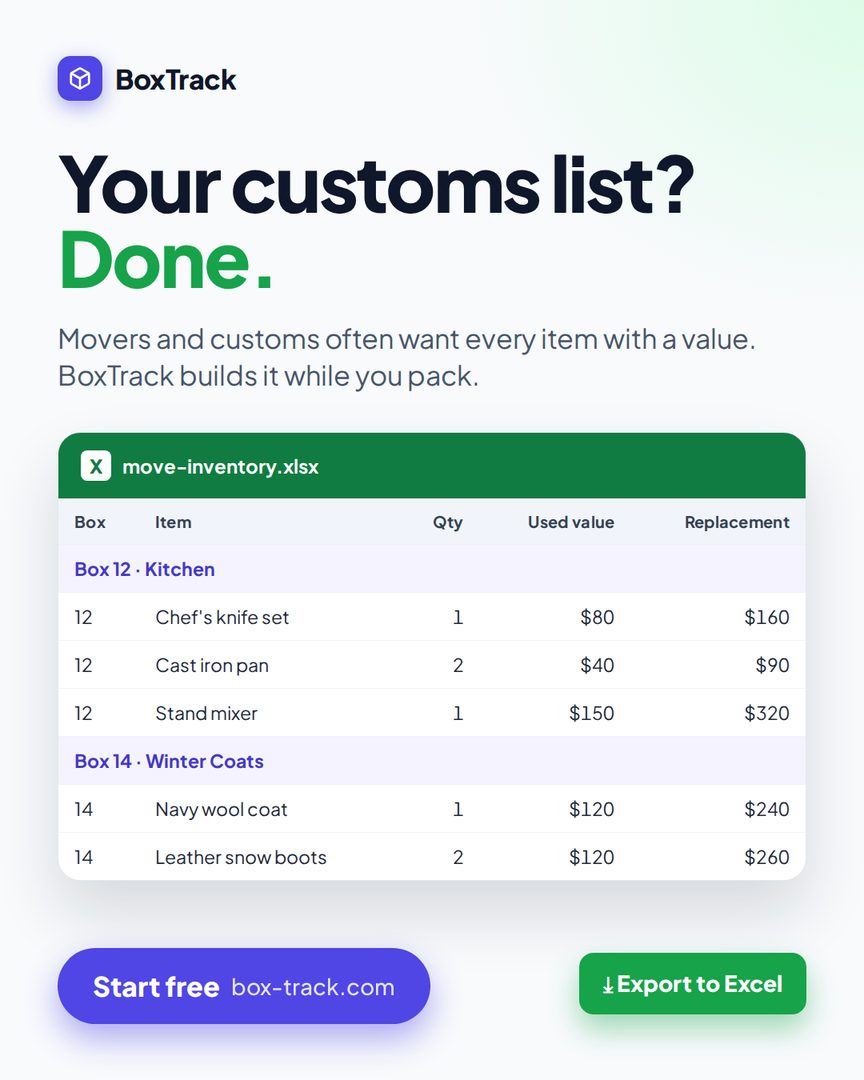
The fastest customs conversations happen when you know exactly what's in each bag and box. BoxTrack keeps a list of what's in every box. Make a box in the app as you pack, snap a photo of what goes in, and AI lists the items with an estimated value for you to check. Keep anything you'll need to declare in one box, so it's easy to point to. Print a QR label for each box, and export the list to Excel when you fill in your customs paperwork. See how BoxTrack works for customs lists. Your first box is free.
This is general information, not legal or customs advice. Rules change and differ by country and by where your goods come from; check CBP, the European Commission and your destination's customs authority before you travel.
Sources
- U.S. Customs and Border Protection, Bringing agricultural products into the United States
- European Commission, Personal imports of animal products
- European Commission, Trade of plants and plant products with non-EU countries
