Moving to Germany: bringing your household goods through customs
Who qualifies for duty-free import of your belongings, the 6- and 12-month rules, form 0350, and how to build the inventory German customs wants.
 The BoxTrack team · · 6 min read
The job offer is in Frankfurt, the flat is signed, and the shipping company has sent you a form in German with a box marked "Übersiedlungsgut." Somewhere in your inbox is a request for "a detailed inventory of the goods." You have a three-bedroom house in boxes and a list that currently says "kitchen stuff (lots)."
Germany lets most people moving their home there from outside the EU bring their belongings in without paying import duty or import VAT. But it's a relief you apply for, not something that happens automatically, and it comes with conditions and paperwork. Here's how it works, and how to get the inventory right before the container is sealed.
What "Übersiedlungsgut" means
Übersiedlungsgut is the German customs term for personal property brought in when you move your normal residence (where you usually live) to Germany. According to German customs (Zoll), it covers:
- household effects: personal effects, household linen, furnishings and equipment for your own use or your household
- private vehicles, such as cars, motorbikes, bicycles and trailers
- household supplies in normal family quantities
- domestic pets and riding animals
What it doesn't cover: alcohol, tobacco and tobacco products, commercial vehicles, and things you use for your trade or business (portable tools of the "applied or liberal arts," like a musician's instrument, are the exception). Those go through customs under the normal rules.
The conditions, in plain terms
Duty-free import is allowed when all of these are true.
1. You lived outside the EU for at least 12 months. Your normal residence must have been outside the EU customs territory for at least twelve consecutive months before you move. If you were posted abroad and had to come back early, customs can still accept it if you can show you meant to stay at least 12 months, for example with your employment contract.
2. The things are yours and you've used them. Goods must belong to you, and anything that isn't used up (furniture, electronics, a car) must have been in your possession and use at your old home for at least six months before you move. That's what stops people from buying a new car or a houseful of furniture just before moving and bringing it in duty-free.
3. You're bringing them in for yourself, not to sell. The goods have to be for your own use at your new home in Germany.
4. You import them in time. Duty-free clearance is generally possible only within 12 months of moving your residence to Germany. If your shipment can't arrive until later, talk to your customs office before the deadline.
5. You don't sell or lend them for 12 months. After the goods are cleared, you can't lend, pledge, hire out or transfer them, whether for money or free, until twelve months have passed. If you do, the exemption is cancelled and the duties become payable after all.
There's also a way to send things ahead. If you ship your goods before you've moved, customs can release them duty-free when you commit to taking up residence in Germany within six months. They may ask for a security (a guarantee) to cover the duties until you do.
The paperwork
The main form is form 0350, Zollanmeldung für Übersiedlungsgut (customs declaration for goods moved in a transfer of residence). Your moving company or its customs broker in Germany usually prepares and files it, but you'll supply the information and sign.
Expect to be asked for:
- your passport, and your residence permit or visa if you need one
- proof you've registered your new address in Germany (the Anmeldung), or a rental agreement or employment contract showing you're moving there
- proof that you lived outside the EU for the past 12 months, such as a deregistration certificate, a lease or utility bills
- an itemized inventory of what you're bringing, in duplicate, signed and dated
- for a vehicle, the registration documents and proof you've owned and used it for six months
Ask your mover for its exact list, because brokers differ, and some will want things translated.
The inventory is where people get stuck
German customs wants to see what's in the shipment. A list that says "40 boxes, personal effects" invites questions, and questions can mean a delay or an inspection. A good inventory:
- numbers every box, and the number on the list matches the number on the box
- lists the main contents of each box, specifically: "books (about 30), desk lamp, printer," not "office"
- calls out anything valuable or new-looking (a laptop, a camera, jewelry, an instrument) with the year you bought it, since anything that isn't consumable has to have been used for six months
- includes estimated values if your mover asks for them
- is in English or German; ask your broker which
Write it as you pack, not afterwards. Once the boxes are taped, "kitchen 3" is all you'll remember.
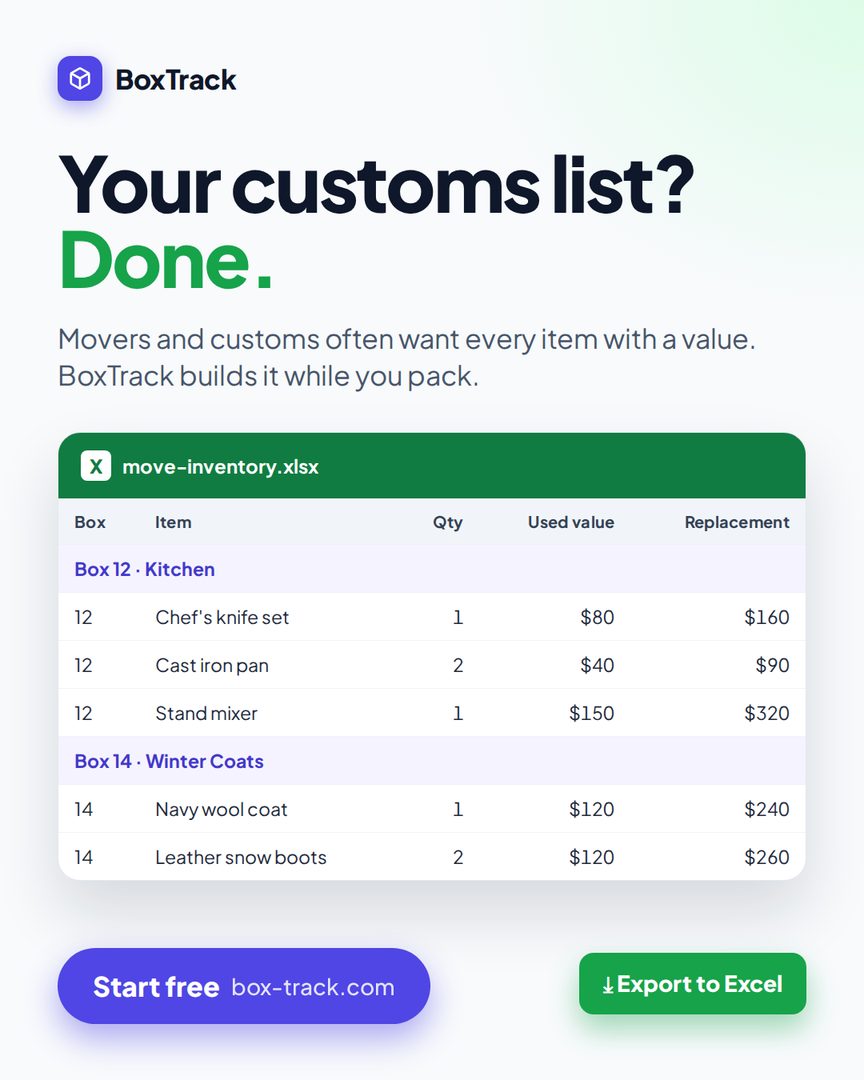
This is the part BoxTrack does for you. Give each box a QR label, take a photo of what goes in before you close it, and the item list with estimated values fills in. When the broker asks for the inventory, you export it to Excel: box number, items, quantities and values. Tag anything you're selling or storing instead of shipping, and the export can leave those out. Your first box is free. (For the general version of this list, see the moving abroad packing list for customs.)
A few things worth knowing before you pack
- Keep alcohol out of the shipment, or expect to pay duty and excise on it. Wine collections are a common surprise.
- Restricted and prohibited goods follow the normal rules even in a household move. Weapons, certain medicines, and items covered by endangered-species rules (some ivory, certain wood or skins) need permits or can't come in. Check with Zoll if you have anything unusual.
- Food is limited by EU rules on animal and plant products. Don't pack the pantry.
- Pets have their own EU entry requirements (microchip, rabies vaccination, and an EU health certificate for animals coming from outside the EU). Start with your vet early, because some steps take weeks.
- Cars are their own project: besides customs, a car from outside the EU usually needs an inspection and German registration. Look into it before you decide whether to ship it.
A short timeline
- 3 months out: get quotes from international movers, ask each how they handle German customs, and get their document list.
- 8-6 weeks out: start packing the things you don't use daily, and build the inventory box by box as you go.
- 4 weeks out: gather your proof of residence abroad, your employment contract or lease in Germany, and the vehicle papers.
- Packing day: check the mover's inventory against yours, and keep a copy of everything.
- After you arrive: register your address (Anmeldung) and send the broker what they need so the shipment clears.
If your plan changes and you're coming back the other way, our guide to moving back to the US covers US customs.
Sources
- German Customs (Zoll), Transferring residence
- EU Council Regulation (EC) No 1186/2009, Title II, relief from import duty for personal property
This is general information, not legal or customs advice. Rules and forms change, and your situation may differ; check with German customs (Zoll) or your moving company's customs broker before you ship.