Home inventory for insurance: what makes a claim easier
What insurers need from your home inventory after a loss, how actual cash value and replacement cost change the payout, and what to record now.
 The BoxTrack team · · 5 min read
The water heater let go on a Saturday while the family was away. By Monday the basement carpet was gone, and so were the boxes stacked on it: two cartons of kids' clothes, the camping gear, a printer, a guitar in a soft case, and the Christmas ornaments. The claims adjuster was friendly and patient, and asked for one thing: a list of what was lost, with what each item was worth.
That list is where a contents claim is won or lost. A home inventory for insurance is the same list you'd make for your own records, with a few extra details that matter when an insurer is the one reading it. Here's what those details are and why.
What the insurer actually asks for
After a loss, your insurer will want you to show what you had and what it was worth. Expect to be asked for:
- a description of each item or group of items
- when you bought it and what you paid, if you know
- its condition before the loss
- proof you owned it: photos, receipts, bank or card statements, appraisals
- serial numbers for electronics and appliances, especially after a theft
The California Department of Insurance puts it simply: take inventory of your belongings before you have a loss. Building that list from memory after a fire or flood, while you're dealing with everything else, is hard, and anything you forget is something you don't get paid for.
Actual cash value or replacement cost: check which you have
This one detail changes what your inventory is worth on paper.
The NAIC, the national association of state insurance regulators, explains the two:
- Actual cash value pays to repair or replace your property based on its value, taking age and wear and tear into account. The NAIC notes it often doesn't pay enough to fully replace what you lost.
- Replacement cost pays what it costs to repair or replace your property with something of like kind and quality.
California's Residential Property Claims Guide gives an example: if a tree falls through the roof onto an eight-year-old washing machine, a replacement cost policy would pay for a comparable new one, while an actual cash value policy would likely pay only a percentage of that.
Your declarations page or policy says which applies to your personal property. Either way, the inventory helps. With actual cash value, the purchase date and condition are what the depreciation is worked out from. With replacement cost, a clear description (brand, model, size) makes it easier to agree on what a "like kind and quality" replacement costs. Some replacement cost policies pay the depreciated amount first and the rest once you've actually replaced the item, so ask how yours works and keep the receipts for what you buy afterwards.
What to record for each item
Not everything needs the same detail. A practical split:
High-value items (jewelry, art, instruments, electronics, collections, good furniture): photo, brand and model, serial number, purchase date and price, receipt or appraisal. Ask your agent whether any of these exceed any special limits your policy sets for categories like jewelry, and whether they should be listed separately.
Everyday items in groups: "Men's dress shirts, 12," "Cookware, stainless set, about 10 pieces," "Children's books, about 150." Add a photo of the group and an estimate of what the group would cost to replace.
Things people forget: the contents of closets, the garage, the attic and the basement; tools; holiday decorations; sporting gear; what's in a storage unit. The Connecticut Insurance Department specifically mentions occasionally used things and items kept outside.
Photos, video and receipts
Photos prove you owned something and show its condition. A slow video walk-through of each room, with closets and drawers open, is the quickest way to capture a lot at once. Then add close-ups of anything valuable, and of serial number labels.
Receipts and statements prove what you paid. You won't have them for everything, and that's fine; a photo plus an honest estimate is still far better than nothing. For new purchases, start the habit now: when something expensive arrives, photograph it, its serial number and the receipt before the box goes in the recycling.
Keep it where a disaster won't reach it
Keep at least one copy away from your home. Connecticut suggests a secure online location, a fireproof box or a safe deposit box. A phone app that syncs to the cloud does this for you automatically.
Using your inventory after a loss
If you do have a claim:
- Tell your insurer promptly and ask what they need and by when.
- Photograph the damage before you throw anything away, and ask before discarding damaged items.
- Send the inventory for what was lost, with photos and any receipts. Mark which items were damaged and which are gone.
- Keep a copy of everything you send and notes of every call.
- Read before you sign. California's claims guide notes that the first check is often an advance, not a final payment, and warns against signing anything that releases the insurer from further liability.
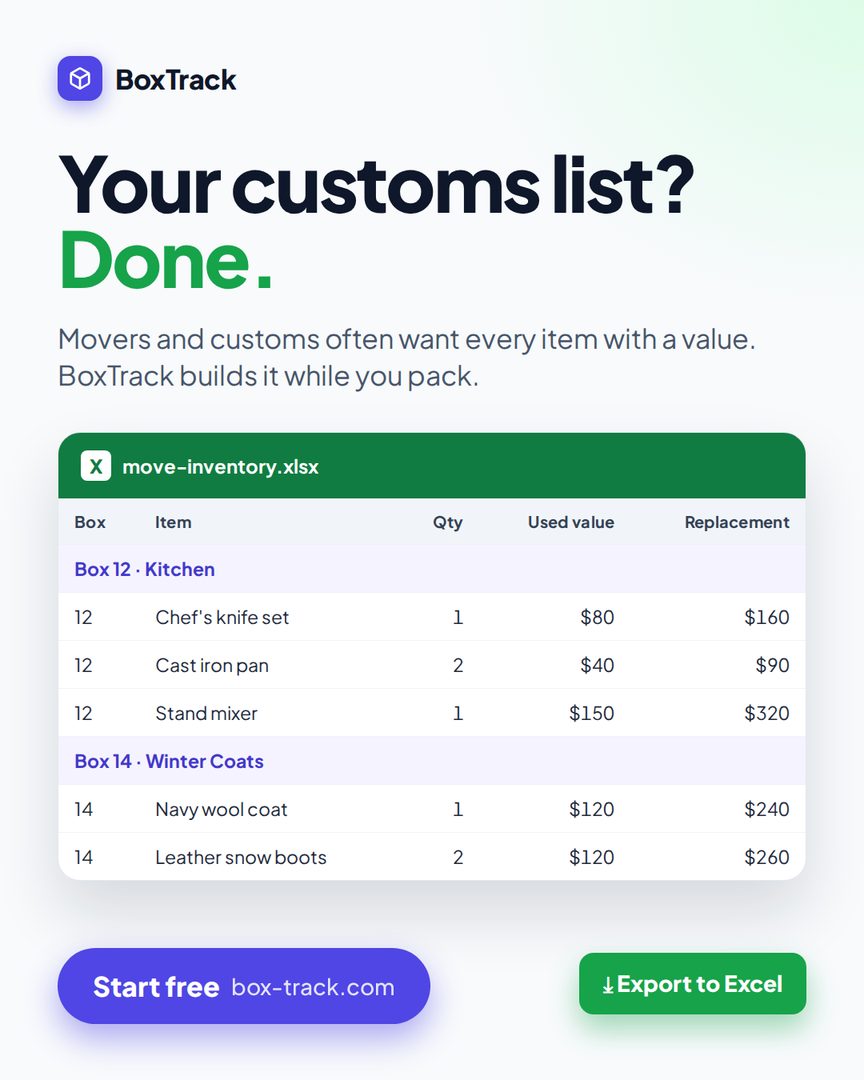
BoxTrack makes the list for you as you go. Snap a photo of a shelf, a closet or a box and the AI scan lists the items with an estimated value you can change. Add photos of receipts and serial numbers to each item, and when you need it, export everything to Excel with items, quantities and values. See how BoxTrack works as a home inventory. Your first box is free.
If you're starting from nothing, our step-by-step guide on how to create a home inventory gets you through the first afternoon.
Sources
- NAIC, What's the difference between actual cash value coverage and replacement cost coverage?
- California Department of Insurance, Home Inventory Guide
- California Department of Insurance, Residential Property Claims Guide
- Connecticut Insurance Department, Consumer advisory, April 4, 2025
This is general information, not insurance or legal advice. What's covered, and how a claim is paid, depends on your policy and your state. Ask your insurer or agent, or your state's department of insurance, about your situation.