Sea container or air freight for a move abroad?
How full containers, shared containers and air freight compare for a household move, how air freight is priced by size, and how to split a shipment.
 The BoxTrack team · · 5 min read
You have three quotes for the move to Lisbon. One is for a 20-foot container, one is for "groupage," and one is for air freight, with a note that the price is "based on volumetric weight." The air quote is for a fraction of your things and costs nearly as much as the container. You start at work in five weeks.
Most families moving abroad end up using more than one of these. The trick is knowing what each one is good for and putting the right boxes in the right shipment. Here's how they compare.
Your three options
A full container (FCL). You get a whole container to yourself. The movers pack it at your home, seal it, and it goes by sea. It's the usual choice for a household with furniture.
A shared container (LCL, groupage or consolidation). Your goods share a container with other people's shipments. Crown Relocations describes this as cost-effective for smaller shipments that don't fill a container, with a full container better suited to larger quantities. The trade-off is time: the container doesn't leave until it's full enough, and it's unpacked at a depot before your part is delivered. Your boxes are also handled more and stacked next to other people's goods, so packing matters more.
Air freight. Fast, and priced by size as much as by weight. Good for what you'll need in the first weeks, not for the sofa.
How big is a container, really?
The two standard sizes are 20 feet and 40 feet, plus a "high cube" 40-foot that's taller. Crown's guide to container sizes gives these rough rules of thumb:
- 20-foot: about 30 cubic meters, the typical contents of a two-bedroom apartment or townhouse
- 40-foot: about 60 cubic meters, a typical four-bedroom home
- 40-foot high cube: about 70 cubic meters, a five-bedroom home, or a three-bedroom home plus a car
Those are averages. A sparsely furnished four-bedroom house might fit a 20-foot; a two-bedroom flat full of books and a piano might not. Movers estimate the volume from a survey, by video or in person, so show them everything, including the garage, the attic and the shed.
How air freight is priced
Air freight is charged on "chargeable weight," which is whichever is greater: what the shipment actually weighs, or its volumetric weight. Maersk's explainer gives the usual formula: length × width × height in centimeters, divided by 6,000, gives volumetric weight in kilograms. Some express couriers divide by 5,000, which makes the same box cost more, so check which number your quote uses.
Here's what that means for a typical moving box. A box 60 × 40 × 40 cm is 96,000 cubic centimeters. Divided by 6,000, that's 16 kg of volumetric weight. If you've filled it with towels and it weighs 6 kg, you pay for 16. If it's full of books and weighs 20 kg, you pay for 20.
So air freight rewards small, dense boxes and punishes big, light ones. Pillows, duvets and stuffed animals are expensive to fly. Pack those in the sea shipment or buy new on arrival.
How to split a shipment
The common approach is a small air shipment for the first weeks and a larger sea shipment for everything else.
Air: what you can't live without until the container arrives.
- work things: the laptop dock, a monitor if you need one, any files
- a few weeks of clothes for the season you're arriving in, and the next
- kids' school things and a few favorite toys
- a basic kitchen kit if you're moving into an unfurnished place: one pan, one pot, a knife, a few plates
- bedding, if your place has beds but no linens (accepting that it's light and bulky)
Sea: everything else. Furniture, the full kitchen, books, off-season clothes, bikes, tools, decorations.
In your suitcase: passports, visas, certificates, medication, jewelry, the hard drive with the family photos, and anything else you can't afford to lose or wait for. Lithium batteries, aerosols and some other items have strict rules for air shipments; ask your mover for its list of what's restricted.
Paperwork for two shipments
Most countries clear a household move as one move, but two shipments mean two sets of paperwork: a separate air waybill and bill of lading, and often a separate inventory for each. Customs will compare each list with what's actually in that shipment.
That's the part people get tangled in. If box 14 was going by sea and ends up on the air pallet, the air inventory is wrong and the sea one is short a box.
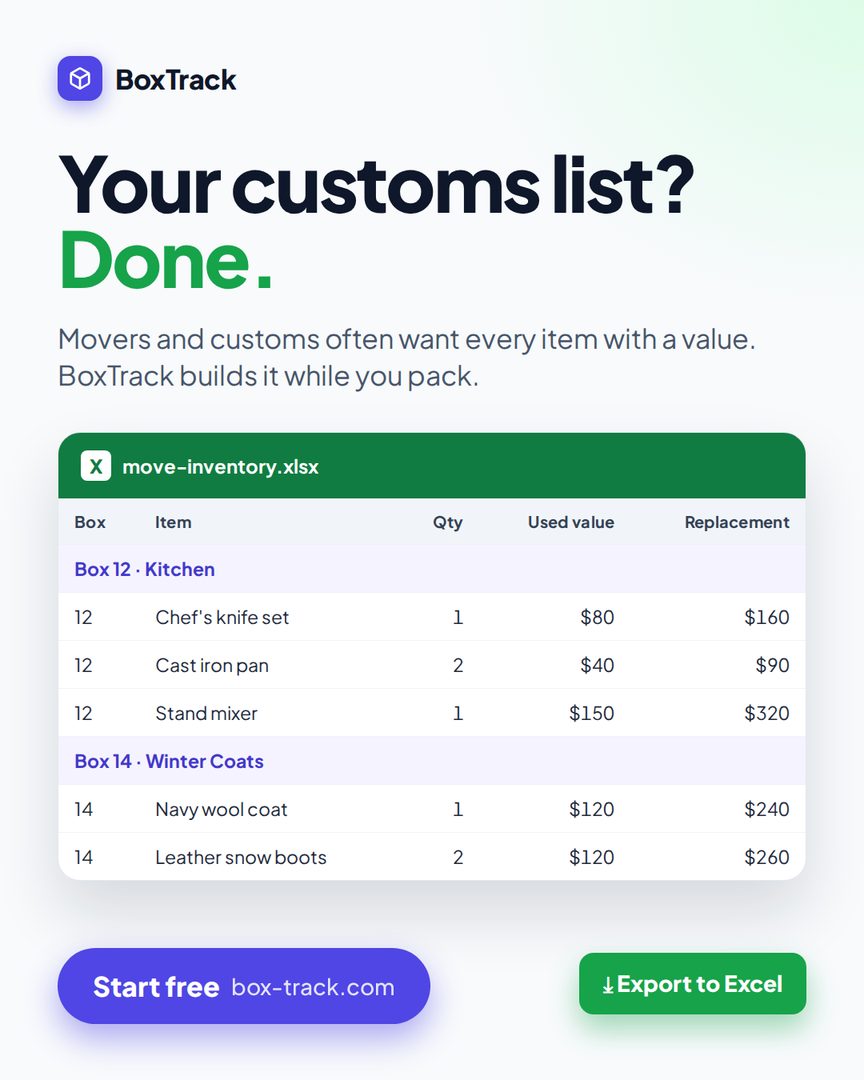
BoxTrack keeps this straight. Every box gets a QR label, you snap a photo of what goes in, and the item list fills in with an estimated value for each item. Put "air" or "sea" in each box's name so you can see at a glance which shipment it belongs to, and export the list to Excel when the mover asks for the inventory: box numbers, items, quantities and values. See how the customs list works. Your first box is free.
For what to put on a customs inventory in general, see our moving abroad packing list for customs.
Questions to ask each mover
- Is the quote for a full container or shared, and if shared, how long before it ships?
- What volume did you estimate, and what happens if we're over?
- For air freight, which divisor do you use: 6,000 or 5,000?
- Is destination customs clearance and delivery included, or is that charged separately?
- What insurance or valuation is included, and how do we claim?
- Do you need one inventory or one per shipment?
Get the answers in writing, and compare quotes on the same basis: door to door, cleared, delivered.
Sources
- Maersk, Air cargo chargeable weight
- Crown Relocations, Understanding shipping container sizes
- Crown Relocations, Your complete guide to sea freight shipping
This is general information, not customs or legal advice. Rules on what can be shipped, and how a household move is cleared, differ by country; check with your mover and the destination country's customs office before you ship.