Moving to Austria with your household goods
How relocation goods clear Austrian customs when you move from outside the EU, with the 6- and 12-month rules, forms ZBefr 2 and 2a, and what to bring.
 The BoxTrack team · · 5 min read
The container left Baltimore in late August with forty-two boxes, a bike and a piano that had been in the family for three generations. By the time it reached Vienna, the family had been in a rented flat for five weeks, sleeping on borrowed bedding. The shipping agent's email was polite and specific: before the goods could be released, customs needed a declaration, proof that they'd registered their new address, and some evidence that the piano and everything else were theirs and had been used.
Moving to Austria from the US, the UK or anywhere outside the EU means your household goods go through customs. If you meet the conditions, they come in free of import charges. If you don't, or the paperwork isn't ready, they can sit in a warehouse while you sort it out.
The basic rule: used goods, moving with you
Austria applies the EU's rules on personal property for people moving their residence into the EU, set out in Council Regulation (EC) No 1186/2009. Austria's Federal Ministry of Finance (BMF) puts the core idea simply: only used goods are free of charges as relocation goods ("Übersiedlungsgut").
The conditions, from the BMF and the EU regulation:
- You must have lived outside the EU for a continuous period of at least 12 months.
- The goods must have been in your use at your former residence for at least six months before you moved.
- The goods must be declared within 12 months of establishing your residence in Austria.
- For 12 months after clearance, you can't lend, pledge, hire out or sell the goods without first notifying customs. The regulation says duty becomes payable if you do.
Relocation goods, per the BMF and EU rules
What doesn't qualify
Some things are excluded no matter how long you've owned them. The BMF and the EU regulation both list alcoholic products and tobacco, commercial vehicles, and goods for business use, with an exception for portable instruments you need for your profession.
New goods are the other trap. Something bought just before the move, still in its box, doesn't meet the six-month use rule. Our guide to whether to ship, sell or store helps decide what's worth bringing at all.
The forms: ZBefr 2 or ZBefr 2a
The BMF names two forms for relocation goods:
- ZBefr 2, the declaration for duty-free relocation goods.
- ZBefr 2a, an application for an advance decision ("Grundlagenbescheid"), which the BMF says is required if a car is among your goods.
If you're shipping through a moving company or freight agent, ask early who files which form. You'll still need to supply the documents and the list.
The documents customs asks for
The BMF lists the kinds of evidence it expects. Gather them before the shipment lands:
- confirmation of your registration abroad and your new registration in Austria
- an employment contract, rental contract or school enrollment that shows you've moved
- for goods that aren't clearly used, proof of earlier use such as an invoice, a delivery note or a warranty card
- for a vehicle, the purchase or lease contract and the registration papers
The BMF also says that if documents are missing, you can pay the charges first and get a refund once you provide the papers. That keeps a shipment from sitting in storage, but it ties up money you'll want for the move.
Registering your address in Austria is one of those documents, so do it as soon as you move in. The Austrian government's portal, oesterreich.gv.at, explains how.
Bringing a car
Cars get extra attention. Besides the ZBefr 2a, the BMF says the standard consumption tax on vehicles (NoVA) is payable before the car's first registration in Austria. If you're deciding whether to ship a car at all, check that cost and the registration steps first.
Make the list before you pack
Customs wants to know what's in the shipment, and your agent is likely to ask for an itemized list. It's much easier to write one as you pack than to reconstruct it in a borrowed flat in Vienna.
| On your list | Why it helps |
|---|---|
| Box numbers | ✓ Matches the list to the boxes |
| Items in each box | ✓ Shows what you're declaring |
| Rough values | ✓ Agents and insurers may ask |
| Purchase dates for big items | ✓ Supports the six-month rule |
| A separate list of anything new | ✓ Keeps it from slowing the rest |
Our guide to moving to Germany covers the same EU rules from the German side, if you're comparing.
Moving to Austria, step by step
- Three months outDecide what to ship; check the 6- and 12-month rules
- Two months outBook the mover; ask who files ZBefr 2
- Six weeks outPack and list every box; gather proof of use for big items
- On arrivalRegister your address; get the confirmation
- Goods arriveSubmit the declaration and documents through your agent
- First 12 monthsDon't sell or lend cleared goods without telling customs
Build the list as you pack
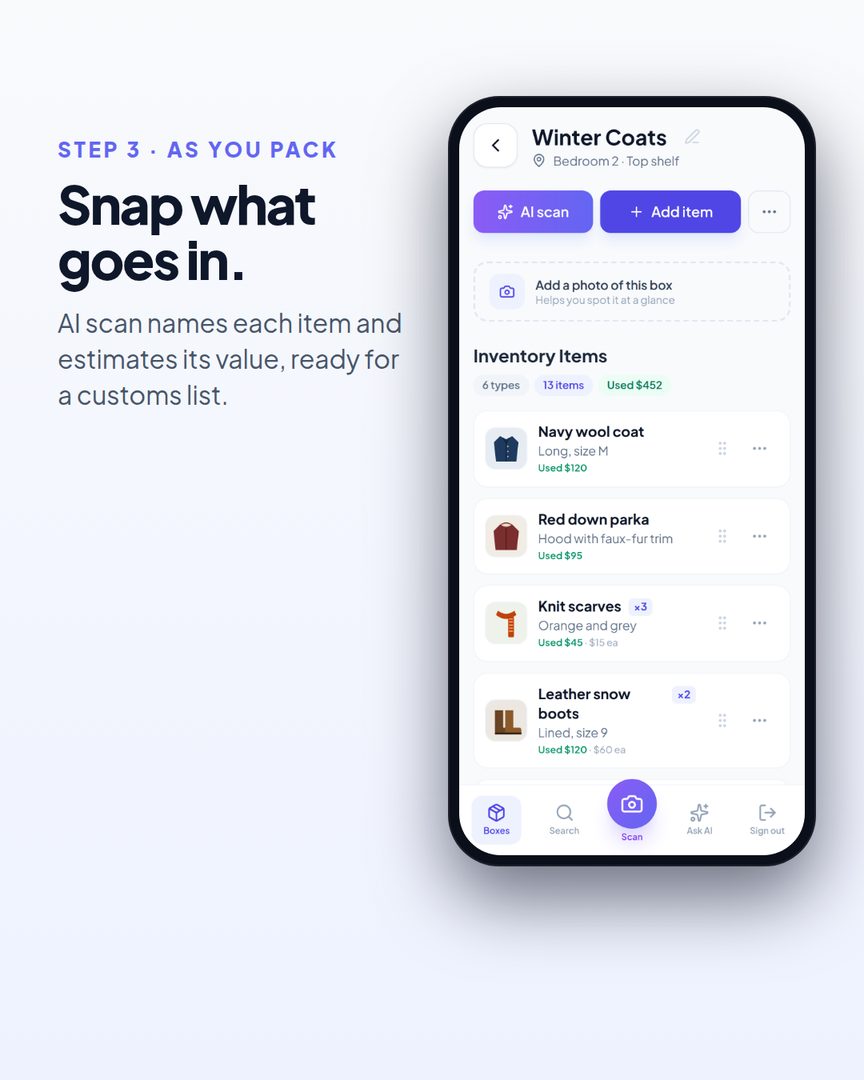
BoxTrack keeps a list of what's in every box. Make a box in the app as you pack, snap a photo of what goes in, and AI lists the items with an estimated value for you to check. Print a QR label for each box, and export the whole list to Excel to share with your agent and fill in the customs paperwork yourself. In Vienna, scan a label to see what's inside before you open it. See how BoxTrack works for customs lists. Your first box is free.
This is general information, not legal or customs advice. Customs rules change; check the BMF's current guidance and ask your moving company or a customs agent about your situation.
Sources
- Austrian Federal Ministry of Finance, Übersiedlung aus einem Nicht-EU-Staat
- EUR-Lex, Council Regulation (EC) No 1186/2009
- oesterreich.gv.at, Meldewesen (registration)
