Moving to Canada from the US: the first month
What to do in your first month after moving to Canada from the US, from your SIN and health coverage to the boxes still on their way.
 The BoxTrack team · · 5 min read
The border officer stamped the paperwork, handed back a numbered copy of the goods list and said, "Welcome to Canada." That was Tuesday. By Thursday the new apartment had two suitcases, an air mattress and a kettle bought at a drugstore. The rest of their things were on a truck somewhere between Ohio and Ontario, and a job started Monday.
The first month after moving to Canada from the US is mostly paperwork and waiting. Some of it can't start until you've arrived. Some of it has a clock running. Knowing which is which makes the month a lot calmer.
Week one: the number you need to work
A Social Insurance Number (SIN) is, in the Government of Canada's words, a 9-digit number you need to work in Canada or access government programs and benefits. Your employer will ask for it.
Service Canada lets you apply online, by mail or in person. It says that if everything is in order at an in-person visit, you'll get your SIN during the visit, and that there is no fee to apply.
You'll need a primary identity document and a secondary one. For permanent residents, the primary document can be a PR card or a Confirmation of Permanent Residence. For temporary residents, it's a work permit, or a study permit that says you may work. The secondary document can be a passport or government ID. Documents must be valid and in English or French.
Plastic SIN cards are no longer issued, so keep the confirmation letter somewhere safe.
Your SIN, per Service Canada
Week one: apply for provincial health coverage
Health care in Canada is run by each province and territory. Immigration, Refugees and Citizenship Canada (IRCC) says each province or territory has its own health care plan, and that it may take up to 3 months for your coverage to start.
IRCC's advice for that gap is plain: it's a good idea to buy private insurance while you wait for government coverage to begin. If you're moving with a job, ask whether the employer's benefits cover you from your first day.
Apply for the provincial card as soon as you have an address. The rules, waiting periods and documents differ by province, so check your own province's health ministry site rather than a general guide.
Weeks one and two: the rest of the basics
Each of these depends on where you land, so treat this as a checklist to look up rather than a set of rules:
- A bank account. You'll need one for payroll. Ask the bank which ID it wants before you go in.
- A phone plan with a Canadian number. Every form you fill in that month will ask for a contact number.
- Your driver's licence. Provinces set their own rules for exchanging a US licence, including how long you can drive on it. Look this up for your province in the first week.
- Your address everywhere. Update it with your US bank, credit cards and anything still mailed to your old place.
Weeks two to four: when your boxes arrive
If your belongings are shipping separately, you'll have listed them as goods to follow when you crossed. The Canada Border Services Agency (CBSA) gave you a numbered copy of the BSF186 form as your receipt. Keep it with your passport. You'll need it when the shipment clears.
Our guide to the goods to follow list covers how the list works and why an item left off it can cost you duty.
When the truck arrives, check every box against the list you gave CBSA and against the mover's inventory. It's easiest to do this as the boxes come off the truck, not three weeks later.
Your first month in Canada
- At the borderShow your goods list; keep the numbered BSF186 copy
- Days 1 to 3Apply for your SIN; set up a phone number
- Week 1Apply for provincial health coverage; buy private insurance for the gap
- Week 1 to 2Open a bank account; look up your province's licence rules
- Weeks 2 to 4Boxes arrive; check them against your list
- End of monthUpdate your address everywhere you still get mail
Unpack in the right order
The first box you open should be the one with sheets, towels, a few dishes, chargers and the kettle you'll stop buying at drugstores. Our guide to what to unpack first goes room by room.
| First week | Unpack now | Can wait |
|---|---|---|
| Bedding and towels | ✓ | ✗ |
| Kitchen basics | ✓ | ✗ |
| Work clothes and laptop | ✓ | ✗ |
| Books and decor | ✗ | ✓ |
| Seasonal clothes | ✗ | ✓ |
Winter coats are the one exception to "seasonal can wait." If you're arriving between November and March, put them in the first box.
One list from Ohio to Ontario
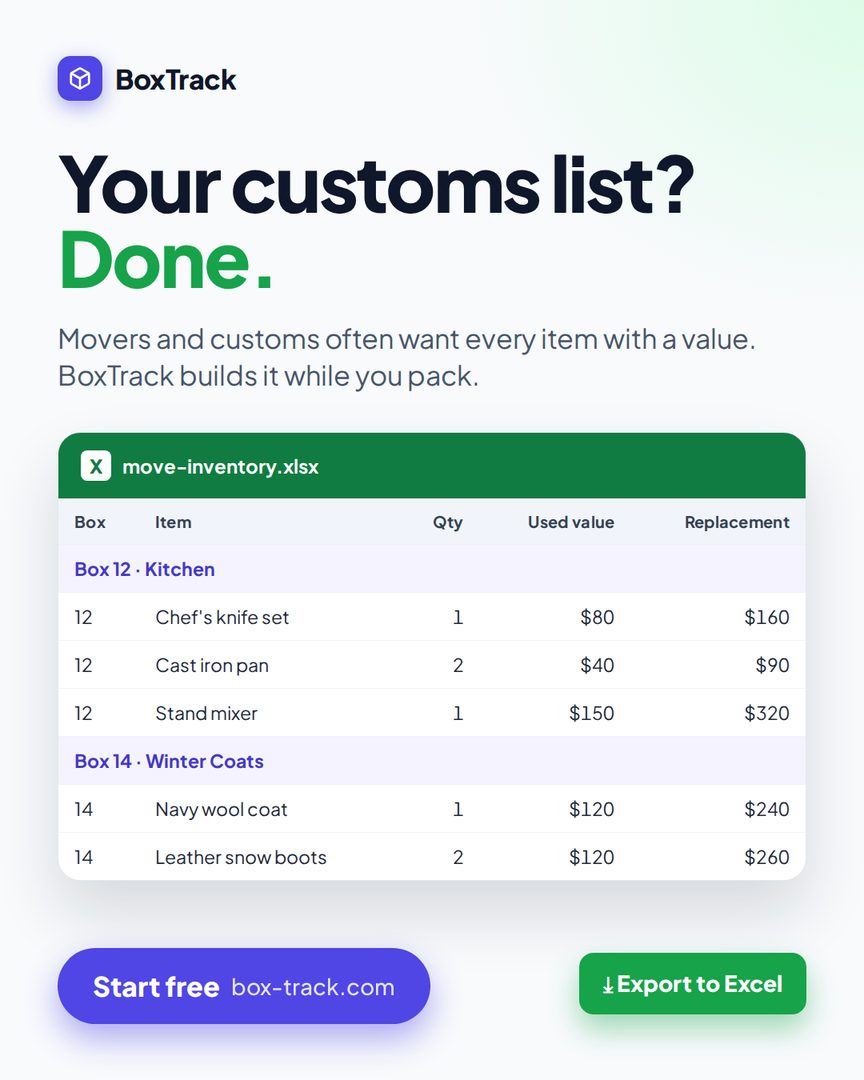
BoxTrack keeps a list of what's in every box. Make a box in the app as you pack, snap a photo of what goes in, and AI lists the items with an estimated value for you to check. Export the list to Excel when it's time to write up your goods to follow yourself. Print a QR label for each box. In Canada, search "winter coat" and get the box number, or scan a label to see what's inside before you open it. See how BoxTrack works for customs lists. Your first box is free.
This is general information, not legal or immigration advice. Rules differ by province and change; check Service Canada, IRCC, CBSA and your province's own sites.
Sources
- Service Canada, Apply for a Social Insurance Number
- Immigration, Refugees and Citizenship Canada, Health care in Canada
- Canada Border Services Agency, BSF186, Personal Effects Accounting Document
