Moving to Canada: the goods to follow list
How settlers list their belongings for the CBSA on forms BSF186 and BSF186A, what "goods to follow" means, and why a missing item can cost duty.
 The BoxTrack team · · 6 min read

The flight to Toronto is on a Thursday. The container with the couch, the bikes and 28 boxes leaves the port in Savannah the week before and won't land for another month. Then the mover's coordinator sends a line that changes the whole packing weekend: "Bring two copies of your full goods list to the airport. The border officer needs to see the shipment before it arrives."
That's how Canada works. If you're settling there for the first time, your belongings can usually come in free of duty and taxes, but the shipment that arrives after you only qualifies if it was on the list you showed the Canada Border Services Agency (CBSA) when you landed. This guide covers who counts as a settler, how the list works and the mistakes that cost money.
Who counts as a settler
The CBSA's memorandum on settlers' effects (D2-2-1) defines a settler as someone entering Canada to set up a residence there for the first time, for at least 12 months. New permanent residents are the usual case.
People who lived in Canada before and are moving back are "former residents," with a different set of rules (memorandum D2-3-2). The list and the form are the same, but the conditions differ, as the table further down shows.
For your goods to come in duty-free as a settler, the memorandum sets three tests:
- You owned them. Leased items don't qualify.
- You had them in your possession. You physically took the goods before you arrived, not just ordered them.
- You used them. Brand-new things still in the box usually don't qualify. The one exception is wedding gifts: if you married within three months before arriving, or will marry within three months after, gifts you received outside Canada qualify even if you haven't used them yet, as long as you owned and had them before arrival.
There's also a rule for after you land. If you sell or give away something you brought in as a settler within 12 months of it arriving in Canada, duty becomes payable on it.
The two forms, and what goes on them
The BSF186, Personal Effects Accounting Document, is the form the officer completes when you arrive. Older guides call it a B4; the forms were renumbered and the old names still float around. The BSF186A is the list of goods that goes with it.
You don't fill out the BSF186 yourself in advance in the usual case. What you prepare is the list. CBSA guidance says to bring two copies and to split it into two parts:
| With you on arrival | Goods to follow | |
|---|---|---|
| What it is | Everything in your suitcases and car | Everything the mover ships |
| Where it's checked | At the airport or land border, the day you arrive | When the shipment clears, using your receipt |
| What happens if it's missing from the list | You can still declare it at the counter | It may be charged regular duty and taxes |
For each item or box, give a description, the value, and the make, model and serial number where there is one. A vague line like "kitchen items" is a problem when the officer is looking at a 40-foot container. The CBSA wants the list detailed enough to avoid confusion when the shipment arrives, especially for anything valuable.
What happens at the border
You show the list at your first point of arrival in Canada. The officer reviews it, completes the BSF186 and gives you a numbered copy as your receipt.
Keep that copy safe. When your shipment lands weeks later, the goods are released against it. Your mover or customs broker will ask for it. The officer marks off what's been delivered so the record stays current.
Here's the part that catches people out. Only things listed as goods to follow on that original BSF186 get the settler exemption when they arrive later. If the receipt is lost, or the shipment holds things that weren't on the list, regular duty and taxes may apply.
A settler move, start to finish
- Weeks beforeWrite the full list, with values and serial numbers, split into "with me" and "to follow"
- Packing dayNumber every box and check the list against what actually goes in
- Arrival dayShow two copies at your first point of arrival; keep the numbered BSF186 receipt
- Shipment landsGive the receipt to your mover or broker so the goods can be released
- The next 12 monthsDon't sell or give away anything you brought in as a settler
Settler or former resident?
The two groups use the same form, but the details differ. The points below come from the CBSA memoranda and the Moving or returning to Canada page:
| Settler | Former resident | |
|---|---|---|
| Who | First time setting up a home in Canada | Lived in Canada before, moving back |
| How long you've owned and used the goods | Owned, possessed and used before arrival | At least 6 months, waived if you lived abroad 5 years or more |
| Any single item worth more than CAN$10,000 | Not in the settler rules | Duty and taxes on the amount above CAN$10,000 |
| Goods to follow | Must be on the original list | Must be on the original list |
Things with their own rules
Some things don't simply ride along on the household list:
- Alcohol and tobacco. They only qualify if they come with you on arrival, within set limits, and alcohol only if you're of legal drinking age in the province where you land.
- Vehicles. A car bought in the US has to meet the Registrar of Imported Vehicles requirements: it must be on Transport Canada's admissible list, have no open recalls, and pass an RIV inspection after import. Vehicles at least 15 years old are generally outside the RIV program but still go through the CBSA.
- Firearms and weapons, food, plants and animals. These are declared separately and have their own rules. Check the CBSA page for each before you pack them.
Make the list once
Most moves to Canada already need an inventory: the mover asks for one, and you'll want one for insurance during the crossing. Write it once, in a form that serves all three.
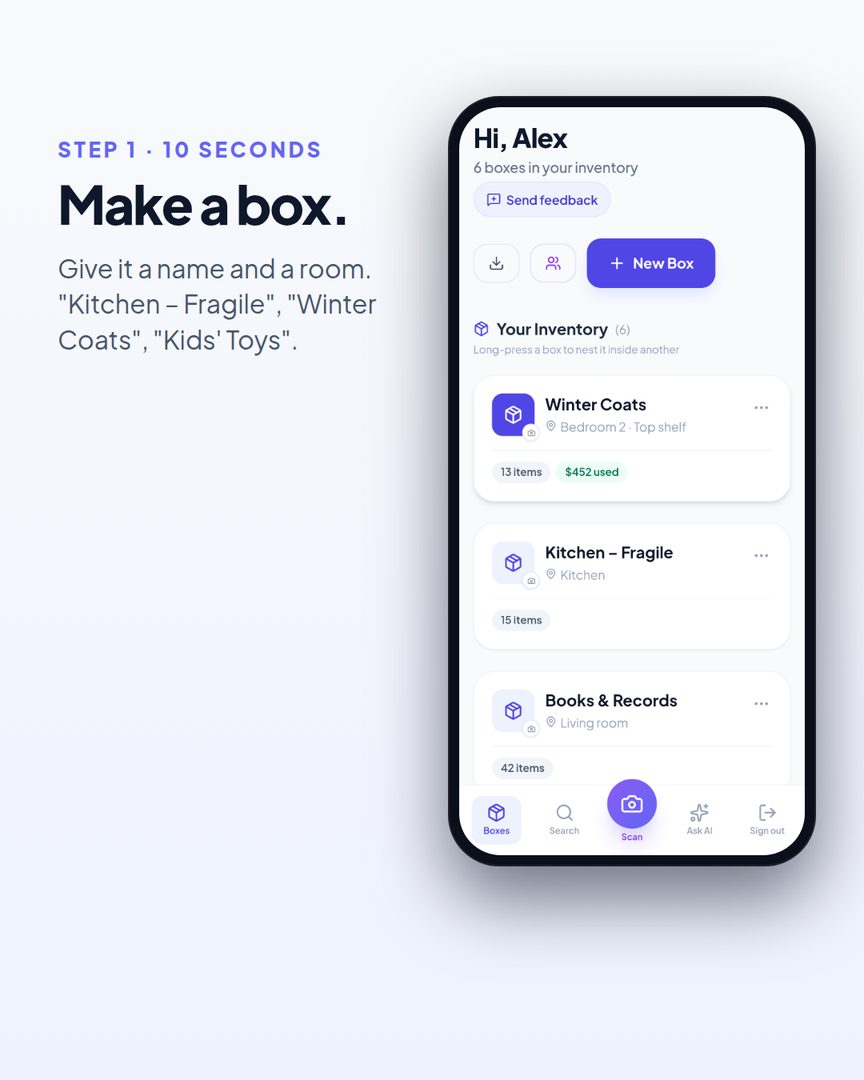
BoxTrack was built for that kind of list. Make a box in the app for each carton, snap a photo of what goes in, and AI writes out the items with an estimated value for you to check. Print a QR label for every box. When you're done, export the whole thing to Excel with box numbers, items, quantities and values, ready to split into "with me" and "to follow". See how BoxTrack handles customs lists. Your first box is free.
If you'd rather start from a spreadsheet, our free customs list template has the columns already set up. And if your move involves a sea container, container vs air freight explains what to send which way.
Sources
- Canada Border Services Agency, Memorandum D2-2-1: Settlers' effects
- Canada Border Services Agency, Memorandum D2-3-2: Former residents of Canada
- Canada Border Services Agency, Moving or returning to Canada
- Canada Border Services Agency, BSF186, Personal Effects Accounting Document and BSF186A
- Registrar of Imported Vehicles, Vehicle admissibility
- Transport Canada, Importing a vehicle from the United States and Mexico
This is general information, not legal or customs advice. Rules change, and the CBSA officer at the border makes the final decision. Check the CBSA's current pages, or ask your mover's customs broker, before you ship.