Moving to Japan: the unaccompanied baggage form
How to declare a household shipment when you move to Japan, from the two-copy customs form at the airport to the six-month window and medicines.
 The BoxTrack team · · 5 min read
The flight landed at Narita a little after four in the afternoon. Two adults, two kids, four suitcases and a toddler asleep on a luggage cart. At the customs desk, the officer asked a question the family had heard about but forgotten in the rush: "Do you have other baggage being sent separately?" Their 25 boxes were somewhere on the Pacific. The answer was yes, and it mattered more than anything in the suitcases.
If you're moving to Japan and shipping household goods, the moment that decides how those goods clear is not when the container arrives. It's at the airport, on the day you land, when you declare them.
The rule in one paragraph
Japan Customs says that when you have unaccompanied baggage, meaning goods sent separately by sea, air or post, you submit two copies of the written declaration form when you enter Japan. A customs officer stamps one copy and gives it back to you. That stamped copy is what you, or your mover, show when the shipment is cleared. Japan Customs says the declaration is needed to get duty and tax exemption for those goods, and that the goods must be cleared within six months of your arrival.
Japan's unaccompanied baggage rules
The form itself
The form is Customs Form C No. 5360, the declaration of accompanied and unaccompanied articles. Japan Customs publishes it in several languages; the English one is C-5360-B. It asks whether you've sent baggage separately, and if you answer yes, that's when the two copies come in.
Japan Customs encourages travelers to declare electronically through Visit Japan Web. If you're shipping household goods, though, check with your mover and Japan Customs how they want the unaccompanied part handled, because the stamped paper copy is what the clearance process has relied on. Japan Customs publishes the form as a PDF, so you can print two copies before you fly.
Fill in the forms before you reach the desk. If your mover has already given you an inventory, it helps to have it with you.
What comes in duty-free
Japan Customs' relocation guidance says that if you're moving to Japan and plan to stay more than a year, household effects you have used, and that you and your family will keep using, can come in free of duty and tax within reasonable limits. Its unaccompanied baggage guidance says that for people who plan to stay more than a year, articles imported within six months of entry are duty-free.
The words "used" and "reasonable" do a lot of work. New items in their boxes, or quantities that look commercial, can be handled differently. Japan Customs says commercial goods or costly items sent as unaccompanied articles may have to go through the same procedures as general cargo.
| Item | Usually fine in the shipment | Notes |
|---|---|---|
| Used furniture, kitchenware, linens | ✓ | Household quantities |
| Used clothes, books, toys | ✓ | List by box |
| Used electronics | ✓ | Check voltage and plugs before shipping |
| New items in original packaging | ✗ | May not count as used household effects |
| Commercial quantities | ✗ | Japan Customs may treat them as general cargo |
| Medicines beyond a month's supply | ✗ | May need an import certificate first; see below |
If you forget to declare
This is the expensive mistake. The declaration on arrival is how Japan Customs knows the separate shipment belongs to a newly arrived resident. If you don't make it, the exemption may not apply, and Japan Customs warns that a false declaration or a failure to declare can bring penalties.
There's a version of the same trap for mail. Japan Customs says parcels sent as unaccompanied baggage should be marked "unaccompanied baggage," or they may be treated as dutiable. If you get a duty notice for a parcel you think should be duty-free, Japan Customs says to ask the customs office that sent it before you pay, because after paying you may not get the duty-free treatment.
Medicines need their own planning
Japan is strict about medicines. The Ministry of Health, Labour and Welfare says that bringing in more than a set amount of medicine for personal use, generally a one-month supply for prescription drugs, requires an import certificate called a Yakkan Shoumei, applied for before you arrive. Some drugs can't be brought in at all, and controlled medicines have separate rules.
Don't put medicines in the household shipment and hope. Check MHLW's guidance for each one, and carry what you need for the first weeks with you, along with the prescription.
A timeline that works
Moving to Japan, step by step
- Three months outGet mover quotes; ask how they handle Japan clearance
- Two months outStart the box-by-box list; set aside new items
- Six weeks outCheck every medicine against MHLW rules; apply for a Yakkan Shoumei if needed
- Packing weekNumber each box and list its contents
- Flight dayFill in two copies of Form C-5360; declare the separate shipment
- At the airportKeep the stamped copy safe and send a scan to your mover
- Within six monthsShipment cleared using the stamped form
Our guide to container vs air freight helps decide what flies with you, and our post on what to ship, sell or store helps with the sorting.
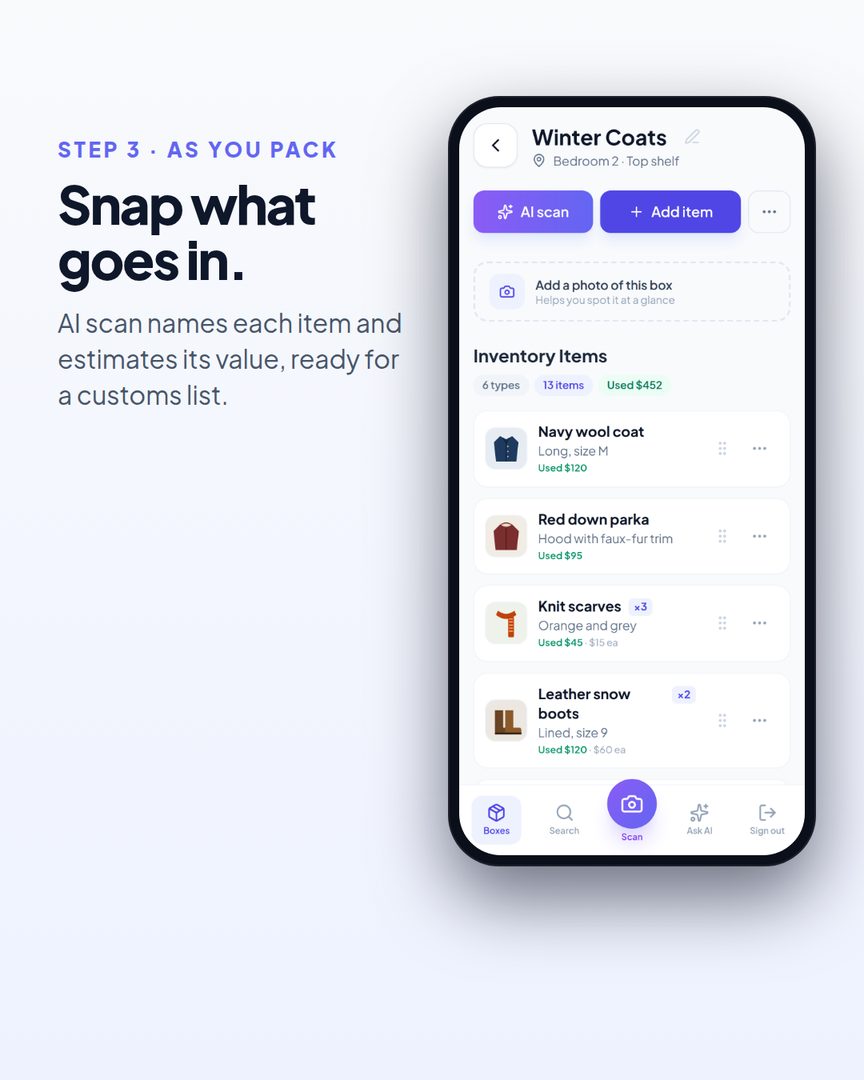
Have the list before the airport
The customs desk is the wrong place to remember what you packed. Your mover will want a clear inventory for clearance, and it helps to have it before you fly.
BoxTrack builds that list while you pack. Make a box in the app for each carton, snap a photo of what goes in, and AI lists the items for you to check, with an estimated value. Print a QR label for every box. Export the whole list to Excel and send it to your mover as the base for their inventory. BoxTrack doesn't fill in Form C-5360, file anything with Japan Customs or translate; it keeps your list matched to what's in the boxes. See how BoxTrack works for customs. Your first box is free.
This is general information, not customs or legal advice. Rules change; check with Japan Customs, the Ministry of Health, Labour and Welfare for medicines, and your moving company.
Sources
- Japan Customs, Procedures of passenger clearance
- Japan Customs, Procedures for declaring unaccompanied articles (7103)
- Japan Customs, Household effects for home relocation (7301)
- Japan Customs, Declaration of accompanied and unaccompanied articles
- Japan Customs, Customs Form C No. 5360-B
- Japan Customs, International parcels sent as unaccompanied baggage (6105)
- Ministry of Health, Labour and Welfare, Information for those bringing medicines for personal use into Japan
