PCS move: keep your own inventory and protect your claim
What to record before the movers come, the two claim deadlines that matter, and how a PPM changes things.
 The BoxTrack team · · 5 min read
The packers left at four. The inventory sheets say "Box 47: misc. kitchen" and "Box 48: misc. kitchen," and the one thing you know for sure is that the good knife set is in one of them. Three months later, at the new duty station, box 48 never comes off the truck.
If you've done a PCS before, you know the government move is a mix of real help and paperwork that matters more than it looks. The moving company (the transportation service provider, or TSP) packs and writes its own inventory, but if something goes missing or breaks, the claim is yours to make, on a clock, with whatever proof you have. This guide covers what to record, the deadlines, and what changes if you move yourself.
Before the packers arrive
Your best evidence is made before anyone touches a box.
Walk through and photograph everything. Room by room, open drawers and closets. Take close-ups of anything valuable or easily damaged: TVs (with the screen on, so it's clear it works), furniture corners, electronics, instruments, artwork, the dining table top. Photos with a date on them are hard to argue with.
Keep serial numbers. Snap the label on the back of electronics, appliances, bikes and tools.
Find receipts for the expensive things. You don't need every receipt, but for high-value items they make a replacement-value claim much easier.
Set aside what doesn't go on the truck. Orders, IDs, passports, medical and school records, the pet's paperwork, chargers, and anything you need in the first two weeks. Put them in a room the packers won't enter, marked clearly.
Separate your pro-gear. Professional books, papers and equipment (PBP&E, or pro-gear) can be excluded from your weight allowance when it's declared and listed. Ask your transportation office how your branch wants it documented, and keep it together so the packers inventory it as pro-gear, not household goods.
On packing day
Stay with the crew, or have another adult there, and read the TSP's inventory sheets before you sign them.
- Check each line describes what's actually in the box. "Misc." is not a description. Ask them to write "kitchen: knives, cutting boards, mixer" instead.
- Look at the condition codes the crew writes for furniture (scratched, dented, and so on). If you disagree, write your own note next to theirs before you sign.
- Count the boxes. Write the total on the last sheet.
- Point out high-value items so they're listed specifically.
- Keep your copy of every page.
Your own box-by-box list
The TSP's inventory tells you there are 90 boxes. It usually doesn't tell you what's in box 48. Your own list does, and it does two jobs: you can find things when you unpack in a house you don't know yet, and you have a record of exactly what was in a box that went missing.
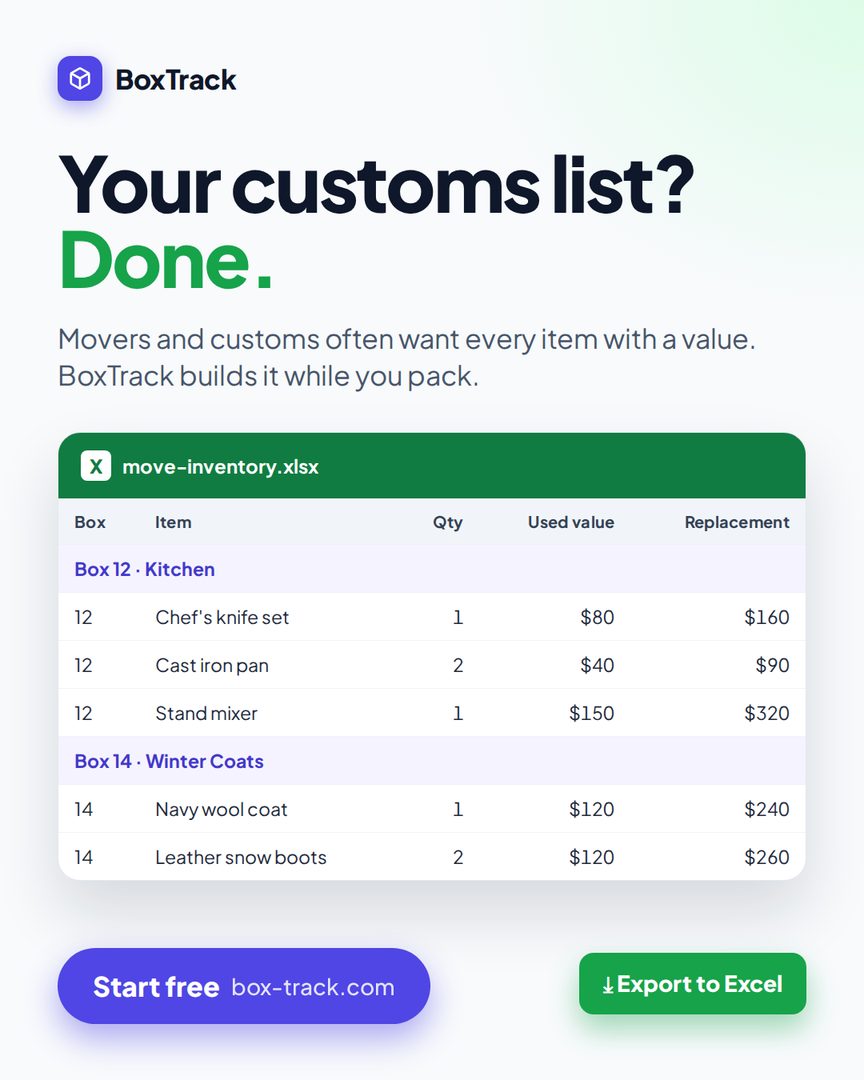
With BoxTrack, each box gets a QR label of its own, alongside the mover's sticker. Snap a photo of what goes in, and the item list (with estimated values) fills in for you. If box 48 doesn't show up, you can export that box's contents to Excel instead of trying to remember what was in it. The first box is free, so you can try it on the junk drawer before the packers come.
Delivery day
Check boxes off as they come in. Note anything missing or visibly damaged on the delivery paperwork before the crew leaves, even if it's just a crushed corner. You don't have to unpack everything that day, but anything you can spot then should go on the form then.
The two deadlines that matter
For moves booked through the Defense Personal Property System (DPS), the claims fact sheets from the services set out two separate clocks, both counted from the delivery date:
- Notice of loss or damage: 180 days. You tell the TSP what's missing or damaged, either on the "at delivery" form the crew gives you or on the "after delivery" form in DPS. Without this notice, neither the TSP nor the Military Claims Office will pay.
- The claim itself: 9 months. Within nine months of delivery, file the actual claim with the TSP. Filing in time is what keeps your right to full replacement value. File late and you lose that right.
The notice is easy to forget because it's separate from the claim. Do it as soon as you find damage, and keep adding to it as you unpack. A list of what was in each box makes both steps much faster.
After you file, the TSP has to acknowledge the claim and either pay, offer a settlement, or deny it within set time limits. If you don't agree with the result, you can transfer the claim to your branch's Military Claims Office. Your local legal or claims office can walk you through that.
If you're doing a PPM
With a personally procured move (PPM, the move once called a DITY), you move some or all of your things yourself. The government pays you based on what it would have cost it to move that weight, up to your weight allowance, and if you spend less, you keep the difference.
That changes what you need to keep:
- Weight tickets. You'll need certified empty and full weight tickets for the vehicle or truck you use. No tickets, no payment for that load.
- Receipts for the truck rental, fuel, tolls and moving supplies, as your branch's checklist requires.
- Your own inventory. There's no TSP to claim against if something breaks in your own truck, so the inventory matters more for your own insurance than for a military claim.
The rules and paperwork change from time to time, so book your counseling session through DPS early and get the current PPM checklist from your transportation office.
A short checklist
- Photos and serial numbers done before packing day
- Pro-gear separated and declared
- Your own list of what's in each box
- TSP inventory read, corrected and copied before you sign
- Missing or damaged items noted at delivery
- Notice of loss or damage within 180 days
- Claim filed within 9 months
For the general version of this, written for civilian interstate moves, see your moving inventory, and why it matters if something breaks. The box labeling guide works the same way for a PCS.
Sources
- Military OneSource, Personal property shipment for your PCS
- Military OneSource, Personally Procured Moves fact sheet (March 2026)
- Military.com, The Personally Procured Move (PPM): steps to take
- U.S. Marine Corps Installations and Logistics, Personal Property Claims Fact Sheet (2024)
- U.S. Navy NAVSUP, Household goods claims fact sheet
This is general information, not legal advice. Rules and forms differ by branch and change over time; your installation's transportation and claims offices have the current requirements for your move.