Small-space packing for an apartment move
How to pack a small apartment without burying yourself in boxes, plan for stairs and elevators, and unpack into a space that's just as tight.
 The BoxTrack team · · 4 min read
By Wednesday night the studio had a path. It ran from the door to the bed, about a foot wide, between two walls of taped boxes. The coffee maker was packed. So was the cutting board, the shower curtain and, it turned out, the scissors needed to open any of it. The move was Saturday. There were three more nights to get through in a 450-square-foot apartment that was now mostly cardboard.
Packing a small place is a different problem from packing a house. There's no spare room to stage boxes, no garage to stack them in, and often no driveway for the truck. The trick is to pack in a different order and plan for the building as much as for your things.
Pack in waves, not all at once
In a big house you can pack a room and close the door. In a studio, every box you fill takes up floor you still live on. So pack in waves, from least used to most used, and stack as you go.
First wave, two weeks out: books, decor, out-of-season clothes, spare linens, anything on a high shelf. These boxes can go against one wall, stacked three high, heaviest at the bottom.
Second wave, one week out: most of the kitchen except one plate, bowl, mug and pan per person. The closet, minus a week of clothes. Bathroom extras.
Last wave, the final two days: the bed, the last of the kitchen, toiletries, chargers, and a first-night box that rides with you.
Leave scissors, tape, markers and a box cutter out until the very end. Put them in the first-night box last.
A studio in three waves
Use smaller boxes than you think
Small apartments usually mean stairs, narrow halls and tight elevators. Small and medium boxes are easier to carry through all of them, and they stack in a corner without blocking the path. Save the big boxes for light, bulky things like pillows and bedding. Our guide to moving box sizes explains which box suits what.
Not sure how many you need? The free moving box calculator gives a starting count.
Pack the empty spaces too. Socks go inside shoes, spices go inside pots, and towels pad the dishes. Every gap you fill is one less box.
Plan for the building, not just the boxes
The building often decides how long a move takes. Ask your building manager or landlord, at both ends:
- whether you need to book the elevator, and for what hours
- whether there's a loading dock or a place the truck can stop
- whether the building needs a certificate of insurance from your mover
- whether moves are allowed on weekends
If you're hiring movers, tell them about stairs, elevators and parking when you get the estimate. The Federal Motor Carrier Safety Administration (FMCSA) glossary lists several extra charges tied to exactly these things:
| Charge | What FMCSA says it covers |
|---|---|
| Long carry | Carrying items an excessive distance between the truck and your door |
| Flight charge (stair carry) | Extra labor and time to move a shipment up or down stairs |
| Elevator carry | Extra labor to move a shipment by elevator |
| Shuttle service | A smaller vehicle, when the big truck can't reach your building |
If these come up on moving day instead of in the estimate, they're a surprise. Our guide to reading a moving estimate covers what to ask.
Measure before you move furniture
Take a tape measure to the new place, or ask for a floor plan. Measure doorways, the elevator, any tight turn in the stairwell, and the spot where the sofa is supposed to go. A sofa that won't fit through the door just goes back on the truck.
If something won't fit, sell it before the move rather than after. The downsizing guide helps with the hard calls.
Unpacking into a small space
The new place is probably just as tight, so the boxes will crowd you on that end too. Unpack the kitchen and bathroom first, then the bed. Break down boxes as soon as they're empty, and get them out of the apartment the same day.
Small apartment move, start to finish
- Two weeks outFirst wave packed; book the elevator at both ends
- Ten days outMeasure doors, stairs and the new space
- One week outSecond wave packed; confirm parking for the truck
- Two days outLast wave; first-night box packed
- Moving dayBoxes out in reverse order; first-night box with you
- First eveningKitchen, bathroom and bed; break down empty boxes
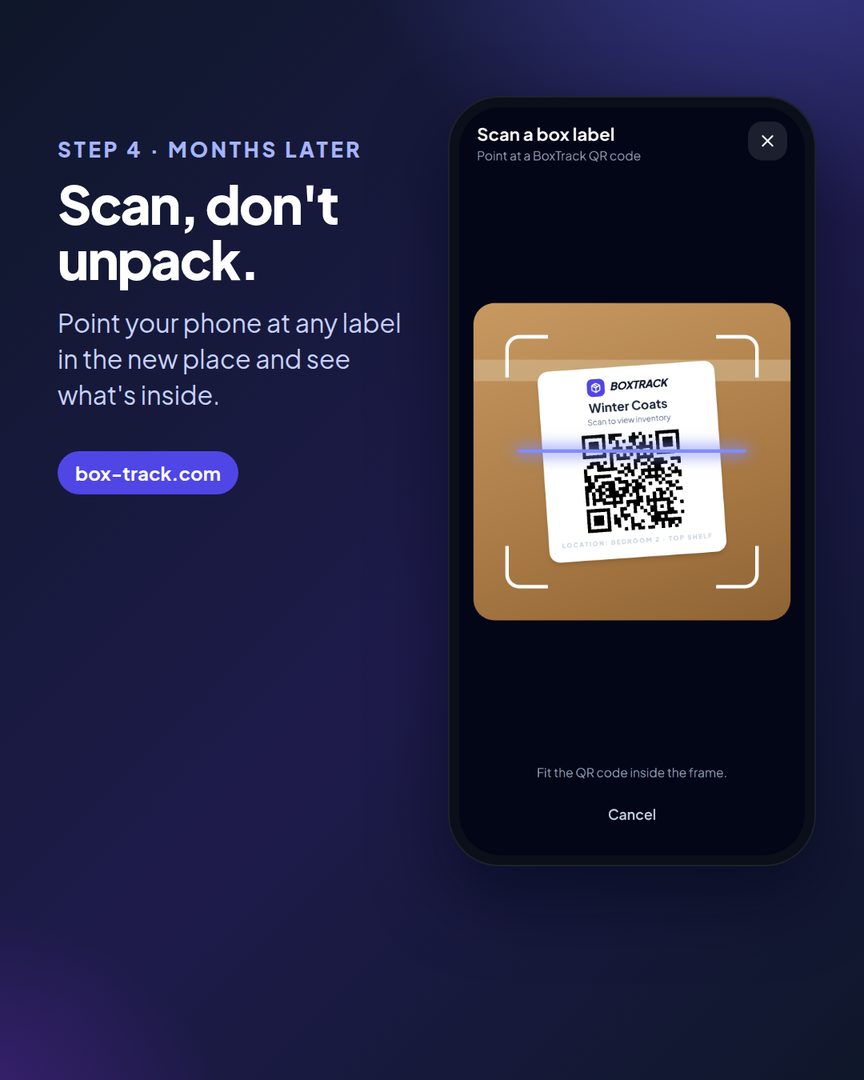
Know which box has the scissors
In a small apartment, a few boxes always stay packed longer than planned, stacked in a closet or under the bed. That's fine, as long as you know what's in them.
BoxTrack keeps a list of what's in every box. Make a box in the app as you pack, snap a photo of what goes in, and AI lists the items for you to check. Print a QR label for each one. In the new place, search "scissors" and get the box number, or scan a label on a box under the bed to see what's inside without opening it. See how BoxTrack works for a move. Your first box is free.
Sources
- FMCSA, Protect your move glossary
