Moving with kids: how to make it easier on everyone
When to tell them, how to handle school records and an IEP, what goes in their first-night box, and how to get through the first weeks.
 The BoxTrack team · · 6 min read
It's 9pm on the first night in the new house. The beds are up, more or less. Your six-year-old is standing in the hallway in yesterday's clothes, asking for the blue blanket with the stars on it, and you have no idea which of the 74 boxes it's in.
Kids handle a move better than most parents expect, as long as they know what's happening and a few familiar things survive the trip. Most of the work is done before the truck comes. Here's what helps, roughly in the order you'll need it.
Telling them
Tell them early enough that it isn't a shock, but not so early that it hangs over months of their life. For most families that's once the move is definite. Little kids need less notice than teenagers; a four-year-old doesn't have much sense of "in three months," while a fifteen-year-old will want time to say goodbye to friends.
Be straight about why you're moving, and about what's going to change and what isn't. Kids worry about specific things: Will my bed come? Can I still play soccer? Is the dog coming? Answer those directly. If you don't know yet, say so, and tell them when you will.
Then give them something to do with the news:
- Look at the new town together on a map. Find the school, the nearest park, the closest pizza place.
- Let them help choose something for their new room, like a paint color or where the bed goes.
- For older kids, look up clubs, teams or activities in the new area before you arrive, so there's something to join in the first few weeks.
Expect some sadness or anger, especially from teenagers. That's a normal reaction to losing friends and a routine, not a sign the move is a mistake.
School records, and an IEP if your child has one
Call the new school or district as soon as you have an address. Ask what they need to enroll your child: usually proof of address, a birth certificate, immunization records, and the last report card or transcript.
You generally don't need to carry the full school file yourself. Under the federal student privacy law, FERPA, a school can send a student's education records to another school where the student is enrolling, without the parent's written consent (34 CFR 99.31). But records can take a while to arrive, so ask the old school for copies of the latest report card, test results and immunization records to keep with you. They'll help if there's a gap.
If your child has an IEP, bring a copy of the current IEP and the latest evaluation, and tell the new district about it when you first call. Federal special education rules (34 CFR 300.323) cover students who transfer during the school year. The new district must provide services comparable to those in the old IEP until it either adopts that IEP or writes a new one. For a move to another state, it can also do its own evaluation first, if it decides one is needed. Comparable doesn't mean identical, so ask early what the plan will look like for the first weeks.
Packing their rooms
Kids' rooms are best packed last, or close to it. A bedroom that's emptied a week early makes a stressful week worse.
Let them help, at a level that fits their age. A young child can choose which toys go in their "first box" and decorate the outside of a few boxes. An older kid can pack most of their own room, with help on anything fragile.
It's also a good moment to let things go: outgrown clothes, toys nobody has touched in a year, the third set of markers. Do this with your child, not behind their back. Kids notice when a favorite thing disappears, and "the movers lost it" doesn't go over well. If you're doing a bigger clear-out of the house, see downsizing before a move.
The first-night box
Every child gets one box, or one suitcase, that travels with you instead of on the truck. It should hold everything they need for the first two nights:
- pajamas and two changes of clothes
- the stuffed animal, blanket or pillow they sleep with
- toothbrush and any medicine
- a nightlight if they use one
- a couple of favorite books, and something to do in the car
- for babies: diapers, wipes, bottles, formula and the travel crib
Label it with their name and "open first," and pack it into your car yourself.
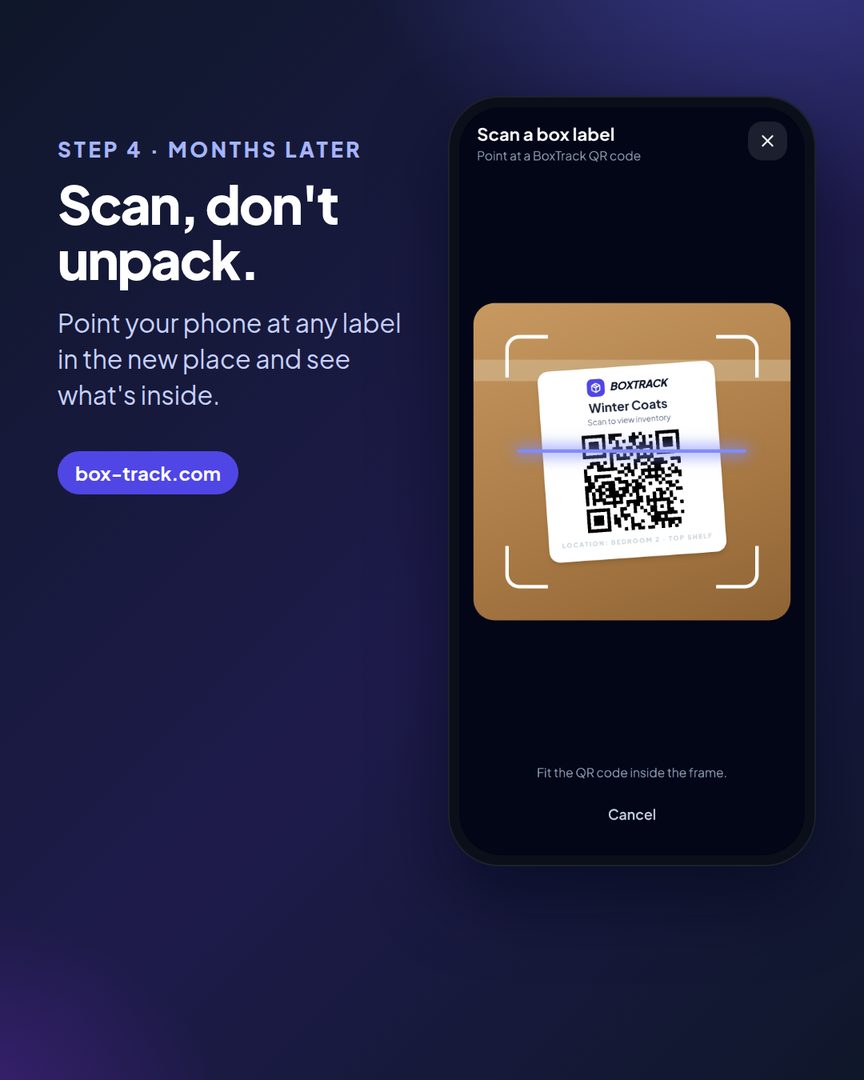
The rest of their room will be in a pile of boxes like everything else. If each box has a QR label and a list of what's in it, you can search for "star blanket" or "soccer cleats" on your phone and go straight to the right box. BoxTrack does that: snap a photo of what goes in as you pack, and the list fills in for you. Kids tend to like scanning the labels too. Your first box is free. The box labeling guide covers the basics if you'd rather use a marker.
Moving day
Moving day isn't a great day for small children to be underfoot. Doors are propped open, heavy furniture is moving, and nobody has a free hand. If you can, have a friend, relative or sitter take younger kids for the day.
If they're staying, give them a job and a base: a room that's already empty, with snacks, a tablet or a few toys, and someone checking in. Older kids can be real help with their own rooms and with keeping track of the pets.
Keep meals and bedtime as close to normal as you can, even if dinner is pizza on the floor.
The first weeks
Set up their bedrooms first, before the kitchen is finished and before the living room is anything but boxes. A familiar bed and a few familiar things on the shelves make the new house feel like theirs a lot faster.
Then get back to a routine: the same wake-up time, the same bedtime, the same Friday-night movie. Find the new park and the library in the first weekend. If you can, visit the school before the first day, so they know where the front door and their classroom are.
Give it time. Some kids settle in a week; some take a whole school year. If a child is still struggling after a couple of months (not sleeping, pulling away from friends, problems at school), talk to their teacher or pediatrician.
And keep the old friendships going, at least for a while. Video calls, a letter to an old classmate, or a visit back if it's close enough: losing everyone at once is the hardest part of a move for most kids. For the rest of the plan, the 8-week moving checklist has the full timeline.
Sources
- eCFR, 34 CFR 99.31: Under what conditions is prior consent not required to disclose information? (FERPA)
- U.S. Department of Education, Student Privacy Policy Office, Does FERPA permit schools to disclose education records to another school where the student seeks to enroll?
- eCFR, 34 CFR 300.323: When IEPs must be in effect (IDEA, transfer students)
This is general information, not legal advice. School enrollment rules differ by state and district; ask the new school what it needs.