How to value household items for an estate
How executors put a value on furniture, dishes, jewelry and other belongings for an estate inventory, using fair market value and an appraiser when it counts.
 The BoxTrack team · · 7 min read
The dining room table seats ten and took two people to carry in 1987. The receipt, found in a drawer, says it cost $3,400. The china cabinet holds a service for twelve, a silver tea set and a shelf of crystal nobody has used since the last wedding. The probate paperwork wants a value for all of it, and the executor, a son who lives two states away, has no idea where to start.
What things cost new rarely matters. For an estate, household items are valued at what they would sell for, used, on the date of death. That number is usually lower than families expect, sometimes much lower. A few things in the house may be worth far more than anyone guessed.
The standard: fair market value on the date of death
Federal estate tax rules define fair market value as the price at which property would change hands between a willing buyer and a willing seller, neither forced to buy or sell, both reasonably informed. The regulation says it is not a forced-sale price. For items generally sold to the public at retail, it's the price the item, or a comparable one, would sell for in the market where it's most commonly sold.
For most household goods, that market is the used one: estate sales, consignment shops, auction houses, online resale. IRS Publication 561, which covers donated property rather than estates, puts it plainly: the fair market value of used household items is usually much lower than the price paid when new. For clothing, it points to what buyers actually pay in used clothing and consignment stores. It's a useful comparison for the everyday items in an estate too.
States use the same idea for probate. Texas law, for example, says each item on the estate inventory is valued at fair market value on the date of the decedent's death.
Go room by room
The federal regulation on household and personal effects calls a room-by-room itemization "desirable." It also lets you group articles in the same room when none of them is worth more than $100. So the kitchen can be "pots, pans and small appliances, $150" rather than forty lines, while the stand mixer that sells for more gets its own.
Household effects, per 26 CFR 20.2031-6
A practical order for each room:
- Photograph the whole room first, then each piece worth listing.
- List furniture, then what's on the walls, then what's in drawers, closets and cabinets.
- Note maker, model, size, condition and any marks or signatures.
- Look up sold prices, not asking prices, for comparable items.
- Group the small stuff by room once you're sure nothing in it stands out.
The regulation also says how some things should be described: paintings by size, subject and artist; Oriental rugs by size, make and condition; silverware by weight in troy ounces. Sets of books by standard authors are listed in separate groups.
When you need an appraiser
The same regulation sets a line for estates that file a federal estate tax return. If jewelry, furs, silverware, paintings, antiques, books, collections and similar articles of marked artistic or intrinsic value total more than $3,000, an expert's appraisal, under oath, is filed with the return. The executor also signs a statement about the completeness of the list and the appraiser's qualifications and independence.
Most estates never file that return. The IRS says the basic exclusion amount is $15,000,000 for 2026. But a professional appraisal can still settle family questions, back up an insurance claim or support a sale.
| Item | Your own research | Professional appraisal |
|---|---|---|
| Everyday furniture and dishes | ✓ Sold prices for similar pieces | ✗ Rarely worth the fee |
| Clothing and linens | ✓ Thrift and consignment prices | ✗ Not needed |
| Fine jewelry | ✗ Hard to judge by eye | ✓ Usually worth it |
| Art, antiques, rugs | ✗ Easy to under or overvalue | ✓ Usually worth it |
| Collections of books, coins, stamps | ✓ A starting point | ✓ When the set looks valuable |
| Silver | ✓ Weigh it in troy ounces | ✓ For maker-marked pieces |
To find one, the three big personal property appraisal groups all point to the same rulebook. The American Society of Appraisers says its members report under the Uniform Standards of Professional Appraisal Practice (USPAP). The International Society of Appraisers says all its members must be USPAP-compliant. The Appraisers Association of America notes that personal property appraisers aren't licensed, so membership in a professional group is one of the most important credentials to look for.
ASA's consumer advice adds two warnings: avoid an appraiser who offers to buy the item, or who charges a percentage of the item's value.
Probate deadlines for the inventory
Many states ask the executor, or personal representative, to file an inventory with values with the court. Two examples:
- California: the inventory and appraisal is due within four months after letters are first issued, unless the court allows more time. The California courts' self-help site says a probate referee usually values the non-cash assets.
- Texas: the inventory is due before the 91st day after the personal representative qualifies, and it must be a verified, full and detailed list of estate property.
Check your own state's court website or ask the estate's attorney for the rule that applies.
Why the number matters later
Values on the inventory follow the items. IRS Publication 551 says the basis of inherited property is generally its fair market value on the date of death, or on the alternate valuation date if the personal representative chooses it. If an heir sells the silver later, that value is the starting point for working out any gain.
It's one more reason to write down how you reached each number: the sold listing, the appraiser's report, the photo.
Valuing a household for an estate
- First weekSecure the house; photograph every room before anything moves
- Weeks 2-3List room by room; group small items under $100
- Weeks 3-4Look up sold prices for furniture and everyday goods
- Same timeBook an appraiser for jewelry, art, silver and collections
- Before the deadlineFile the inventory and appraisal with the court
- Before sale or splitKeep the photos and reports with the list
Our guide to the estate cleanout inventory covers the first walk-through, and home inventory for estate planning covers making the list while a parent can still help. The free estate inventory template has a spot for each room.
Questions
What value do you use for household items in an estate?
Fair market value on the date of death: what a willing buyer would pay a willing seller, neither forced to act. For most furniture, dishes and clothing, that's the used price, which is usually much lower than what the item cost new.
Do I need an appraisal for everything in the house?
No. Federal rules let you group items in the same room that are each worth $100 or less. For estates that file a federal estate tax return, an expert's appraisal is required when art, jewelry, silver, collections and similar valuables total more than $3,000.
How do I find a qualified personal property appraiser?
Look for membership in a professional group such as the American Society of Appraisers, the International Society of Appraisers or the Appraisers Association of America, which all point to USPAP standards. Avoid appraisers who offer to buy the item or charge a percentage of its value.
How long does an executor have to file the inventory?
It depends on the state. California gives four months after letters are first issued, and Texas requires the inventory before the 91st day after the personal representative qualifies. Courts can sometimes extend the time.
The list, with values, in one place
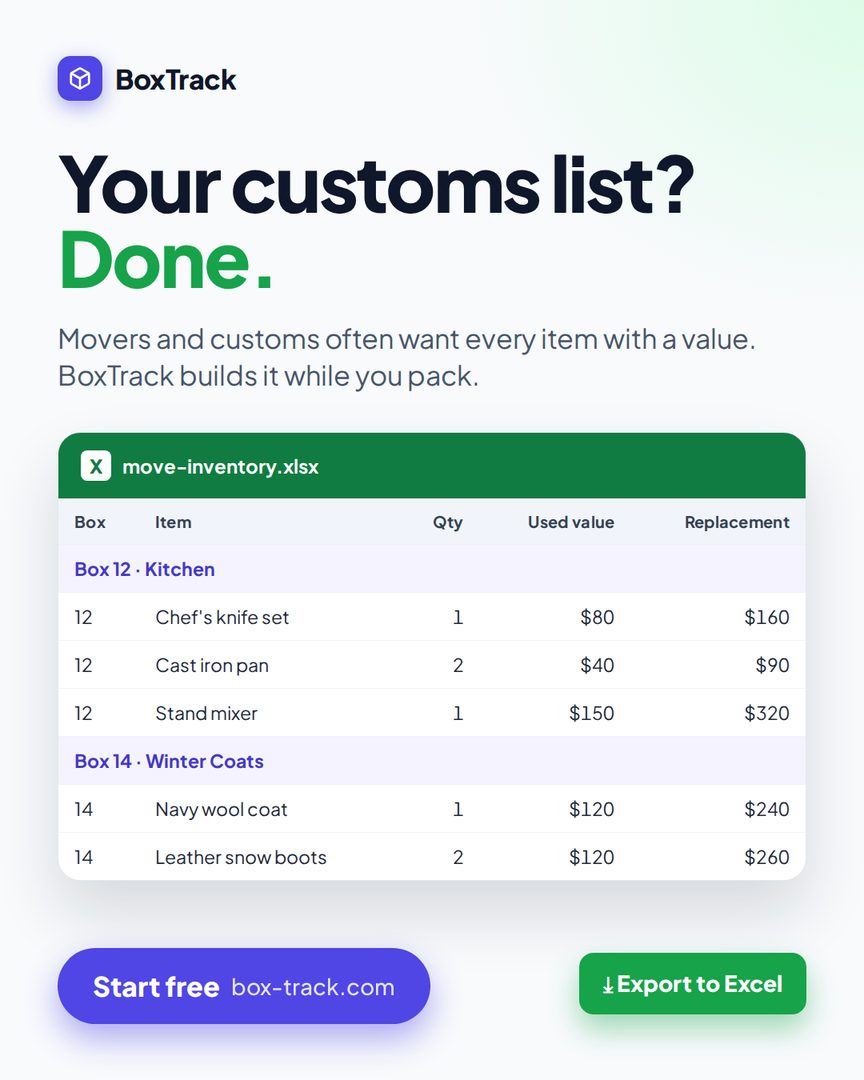
BoxTrack keeps a list of what's in every room, box and closet, with photos and values. Make a box in the app for each room, snap a photo, and AI lists the items with an estimated value for you to check and correct against sold prices or the appraiser's figure. Note condition and maker in each item's description, and share the boxes with the rest of the family. Export makes a family and estate report with quantities and values. See how BoxTrack works for estate inventories. Your first box is free.
This is general information, not legal or tax advice. Estate and probate rules vary by state; ask the estate's attorney or a tax professional about your situation.
Sources
- Cornell LII, 26 CFR 20.2031-6, Valuation of household and personal effects
- Cornell LII, 26 CFR 20.2031-1, Definition of gross estate; valuation of property
- IRS, What's new, estate and gift tax
- IRS, Publication 551, Basis of assets
- IRS, Publication 561, Determining the value of donated property
- American Society of Appraisers, FAQs for consumers
- International Society of Appraisers, What is USPAP
- Appraisers Association of America, About appraising
- California Probate Code section 8800
- California Courts Self-Help Guide, Formal probate
- Texas Estates Code section 309.051