Home library organization: 7 ways to shelve your books (and find any of them)
Home library organization ideas that actually work, by genre, author, color or reading status, plus how to catalog the shelves so you never buy the same book twice.
 The BoxTrack team · · 4 min read
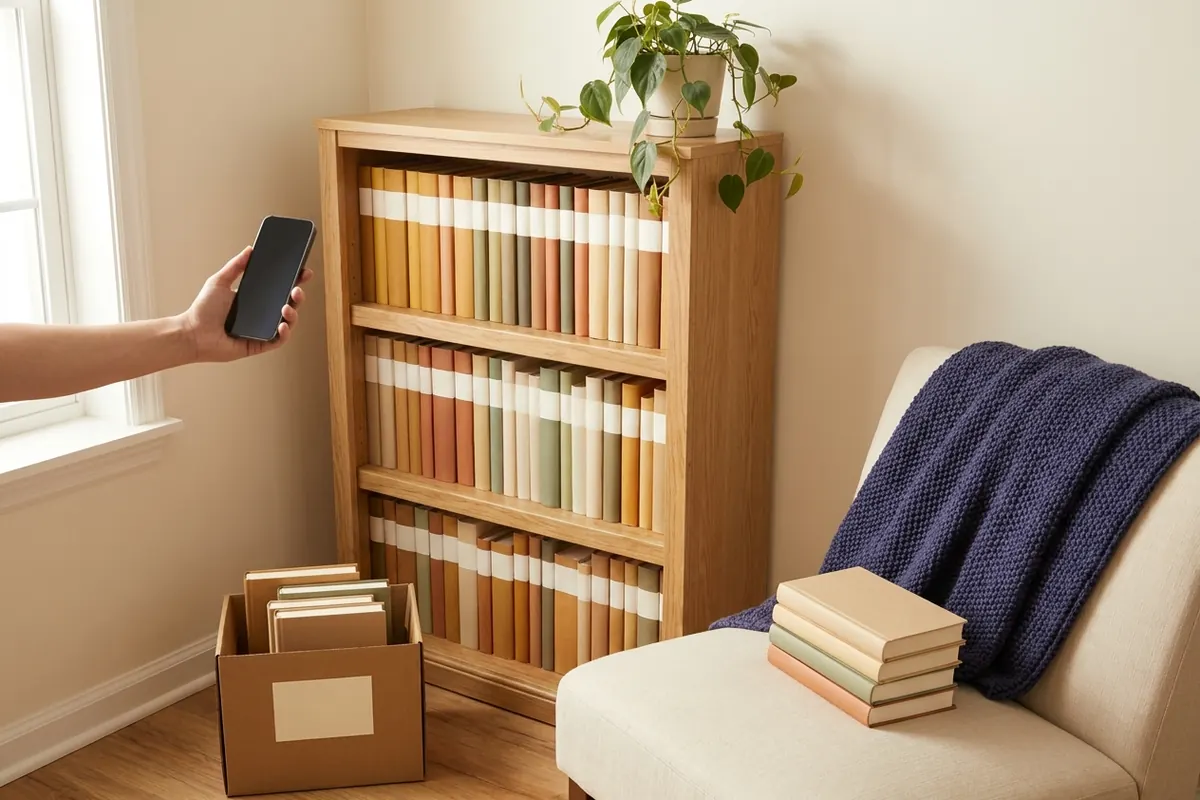
It was the third copy of the same paperback that did it. Not a rare book, not even a great one: a perfectly fine novel that kept looking unfamiliar in the bookshop and very familiar on the shelf at home, next to the other two. Every book lover has a version of this story. The shelves grew faster than the system, and now the system is "I know it's in here somewhere."
Organizing a home library comes down to two choices: how you put the books on the shelves, and how you remember where they went. Get both right and the shelves can be as pretty, or as chaotic, as you like.
1. By genre, then author
The bookshop method, and the most popular for a reason. Group fiction, history, cookbooks, poetry and so on, then put each group in order by the author's last name. It's easy to keep up, because a new book has an obvious place. Give each genre its own shelf or bookcase if you can, so it can grow without a reshuffle.
2. Strictly by author, A to Z
One long alphabet, no categories. It suits readers who mostly read fiction and always know who wrote what. It's the easiest to search by eye, and the hardest to keep tidy: one new arrival near the start of the alphabet means shifting everything after it. Leave a little gap at the end of every shelf.
3. By color
The rainbow shelf looks wonderful and is famously hard to search, unless you remember what color every cover is. If you love the look, color works as long as something else remembers where each book is (see the last section).
4. Read, reading and to-be-read
Some readers keep a shelf for the books waiting their turn, often by the bed, and move each one to the main shelves when it's finished. It's motivating, and it keeps the stack from silently tripling.
5. By room
Cookbooks in the kitchen, children's books in their rooms, reference by the desk, and fiction in the living room. Books live where they're used. It works well with any of the orders above inside each room.
6. Keep the special ones apart
First editions, signed copies and family books do better on a shelf of their own, out of direct sunlight and away from exterior walls, where they're easy to grab in an emergency. The Library of Congress advises keeping books where the relative humidity stays between 35 and 50 percent, and not in a basement, attic or garage. Our rare books inventory guide covers what to record for each one.
7. Shelve for the books, not just the look
A few rules that keep books in good shape, whatever the order:
- Stand books upright, snug but not packed tight, and use bookends for half-empty shelves.
- Lay very tall or heavy books flat rather than letting them lean.
- Keep shelves out of direct sun, which fades spines.
- Keep books off the floor, and away from pipes and bathroom walls.
The part that actually ends the third-copy problem: a catalog
Any order works once you can look a book up. A home library catalog is just a list of every book with the shelf it's on, and it turns "it's in here somewhere" into "living room bookcase, shelf 2." It also means you can check from the bookshop whether you already own something, keep track of books you've lent out, and show your insurer what was on the shelves if a pipe ever bursts.
The old way to make one was typing every title, or scanning each book's barcode one at a time. The faster way is to photograph each shelf and let an app read the spines. Our guide to cataloging your book collection walks through it, including what to record and how to take a shelf photo the app can read.
How BoxTrack does it
Make a box for each bookcase, and a box inside it for each shelf. Snap a shelf with the spines facing out, and Pax, BoxTrack's helper, lists each title he can read, with what it would cost to replace. Scan a book's ISBN barcode for any book you want recorded exactly. Then search "Beloved" and BoxTrack tells you the bookcase and the shelf. Reshelve, and moving a book to another shelf is a tap. Thinning the shelves before a move? Tag books Sell or Donate and see each pile.
Pax lists what he can read, so check the list against the shelf, and treat his values as estimates: rare books deserve an appraiser. Learn more on our book catalog page, or see how BoxTrack compares with Libib, LibraryThing and other book catalog apps.
Questions
What is the best way to organize a home library?
The best way to organize a home library for most people is by genre, then by author's last name within each genre, the way bookshops do. It's easy to keep up because every new book has an obvious place. Whatever order you choose, a catalog with each book's shelf lets you find any book.
How do I organize books by color and still find them?
To organize books by color and still find them, keep a catalog that records each book's shelf, so you search the list instead of remembering cover colors. A book catalog app that lists a whole shelf from one photo makes this quick.
How do I stop buying books I already own?
To stop buying books you already own, keep a catalog of your home library on your phone and check it before you buy. Apps can add books by scanning the ISBN barcode or by reading the spines in a photo of each shelf.
Where should I not keep books?
The Library of Congress advises against storing valuable books in basements, attics or garages, where temperature and humidity swing, and recommends relative humidity between 35 and 50 percent. Keep books out of direct sun, off the floor and away from pipes.
