How to spot a moving scam before you sign
The warning signs of a rogue interstate mover, the federal rules that protect you on price, and how to check a company in five minutes.
The quote came in on the phone, and it was the cheapest by a mile. Nobody looked at your stuff, but the salesperson was friendly and said they could hold the date if you sent a deposit today. Three weeks later the truck shows up, the crew says your load is twice the estimated weight, and your furniture isn't coming off until you pay double.
That's the classic hostage-load scam, and the Department of Transportation's Inspector General lists it among the household goods moving fraud it investigates. Most of it is avoidable, because the pattern is the same almost every time, and federal rules give you more leverage than most people realize.
This guide is about interstate moves (from one state to another), which are regulated by the Federal Motor Carrier Safety Administration (FMCSA). Moves inside one state fall under state rules.
The red flags
FMCSA's Protect Your Move program and its Ready to Move brochure describe the same warning signs. Be wary when a company:
- won't look at your belongings, in person or on video, and quotes a price over the phone or online sight unseen
- asks for a large deposit or full payment before the move, especially in cash or by wire
- has a website with no local address and no USDOT number, MC number or insurance information
- won't give you a written estimate, or the estimate is vague about what it covers
- doesn't give you the federal "Your Rights and Responsibilities When You Move" booklet and the "Ready to Move" brochure, which interstate movers and brokers are required to provide
- answers the phone with a generic "Movers" instead of a company name
- shows up on moving day in a rented truck with no company name
One flag on its own isn't proof. Two or three together should end the conversation.
Look the company up before anything else
Every interstate mover and moving broker has to be registered with FMCSA. Checking takes a few minutes.
- Get the company's USDOT number (and MC number if they have one). A legitimate interstate mover will give it to you without hesitation.
- Go to FMCSA's Search for a Registered Mover page and search by name or number.
- Check that the registration is active, that the name and address match what they told you, and whether they're registered as a carrier (they move your goods) or a broker (they arrange the move and hand it to a carrier).
- Look at their complaint history in the same search, and in the National Consumer Complaint Database.
Brokers are legal, but you should know if you're talking to one. FMCSA has a short explainer, Movers Versus Brokers. If a broker sells you the move, ask which carrier will actually show up, and look that company up too.
Insist on a survey and a written estimate
Under federal rules (49 CFR 375.401), an interstate mover has to base your written estimate on a physical survey of your belongings. That survey can now be done by live or recorded video. There are two exceptions: when your home is more than 50 miles from the mover's agent preparing the estimate, and when you waive the survey in writing before loading.
Don't waive it. A company that won't look at your stuff can't give you a real number, and a low number it can't stand behind is how the hostage-load scam starts.
Binding vs. non-binding estimates
You'll get one of two kinds of written estimate.
| Binding | Non-binding | |
|---|---|---|
| What it means | A fixed price for the goods and services listed | A best guess; the final price depends on the actual weight and services |
| What you pay at delivery | The estimated amount (plus any services you add later) | No more than 110% of the estimate at delivery, plus services you add later |
| Watch for | Items not on the estimate | A suspiciously low estimate |
The 110% rule is the part scammers count on you not knowing. On a non-binding estimate, the most a mover can demand at delivery is 110% of the estimate, plus charges for services you asked for after the bill of lading was issued and for "impracticable operations" (a long carry or a narrow street the mover couldn't have known about, for example). If you pay that amount, the mover must hand over your goods (49 CFR 375.407). Anything above it gets billed later, giving you time to dispute it.
Keep your own record
A list of what's in each box, with photos, is your evidence if the crew disputes what was loaded, if something goes missing, or if you need to file a claim. Write the box count on the mover's inventory sheet before you sign it, and keep a copy.
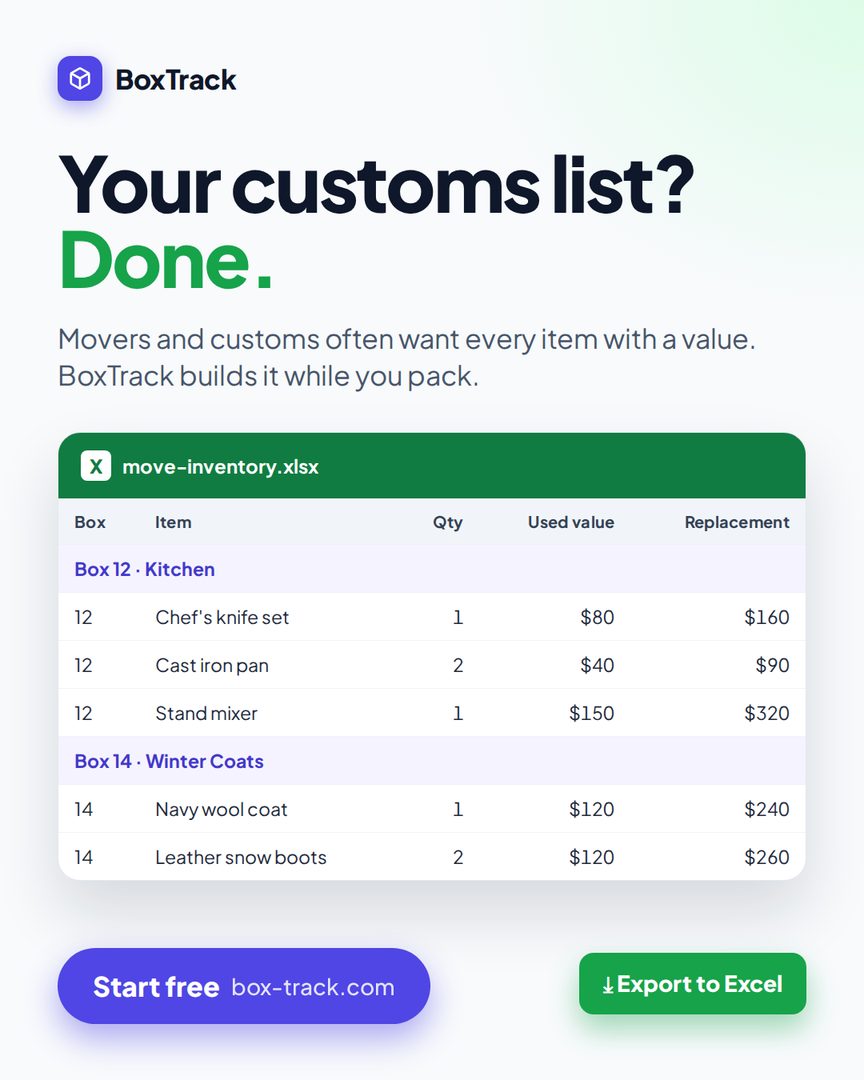
If you use BoxTrack, each box gets a QR label and its own item list, built from photos as you pack, and you can export the whole inventory to Excel. That's the list to bring to the walkthrough. For what to do at pickup and delivery, see your moving inventory, and why it matters if something breaks.
If it goes wrong anyway
- They demand more than 110% of a non-binding estimate at delivery. Offer to pay 110% plus any legitimate added services, in writing. Refusing to deliver after that is a violation.
- Your goods are being held. Contact local police if you believe your property is being held illegally, and file a complaint with FMCSA right away.
- You want to report a mover or broker. Use the National Consumer Complaint Database or call FMCSA's hotline at 1-888-DOT-SAFT (1-888-368-7238). The DOT Inspector General also takes fraud reports through its household goods fraud page.
- Something was lost or damaged. File a written claim with the mover. You generally have nine months from delivery to do it.
A good mover won't mind any of these checks. A bad one usually gives itself away at the first: ask for the USDOT number and see what happens.
Sources
- FMCSA, Protect Your Move
- FMCSA, Ready to Move? brochure
- FMCSA, Search for a Registered Mover
- FMCSA, Movers Versus Brokers: What is the Difference?
- FMCSA, National Consumer Complaint Database
- eCFR, 49 CFR 375.401: Must I estimate charges?
- Cornell LII, 49 CFR 375.407: Relinquishing a shipment under a non-binding estimate
- U.S. DOT Office of Inspector General, Household Goods Moving Fraud
This article is general information, not legal advice. It covers interstate moves in the US; moves within one state are governed by that state's rules.