Moving to the UAE with household goods
How used household goods clear customs when you move to the UAE, using Dubai Customs' rules, what papers you need, and what to keep out of the boxes.
 The BoxTrack team · · 5 min read
The offer letter came in March, the job in Dubai started in June, and the container quote came back with a question the family hadn't thought about: "Do you have your residence visa yet? We'll need a copy for clearance." The visa was weeks away. The packers were booked for the following Monday.
The customs side of a move to the United Arab Emirates goes most smoothly when two things line up: your residence paperwork, and a clear list of what's in the shipment. This guide uses Dubai Customs' published rules. If your goods will clear in another emirate, check with that emirate's customs authority and your mover.
Who can bring household goods in duty-free
Dubai Customs says personal effects and used household items brought in by foreigners coming to live in the country for the first time are exempt from customs duty. The same applies to UAE nationals returning from abroad. The conditions in Dubai Customs' guidance:
- The items must be used. Dubai Customs says new personal effects and household items aren't exempt, and duty is charged on them.
- The quantity should suit furnishing a home, not a shop.
- The goods and the declaration should be in the name of the person moving.
- Foreigners need proof of work and residence in the UAE.
Dubai Customs also says that goods its inspectors find to be in commercial quantities are charged 5 percent customs duty.
Dubai Customs' rules in brief
The papers your mover will ask for
For clearing personal effects, Dubai Customs lists a copy of your passport or Emirates ID, a copy of your residency visa and a written list of the goods. Your moving company or its agent in the UAE normally handles the clearance and will tell you exactly how they want each document.
Because the residence visa is on that list, plan the shipment around it. Ask your mover what happens if the goods arrive before your visa is issued, and what that would cost. That's our reading of the document list, not a Dubai Customs rule, so confirm the details with your mover.
What to keep out of the boxes
The UAE separates goods into prohibited goods, which can't be brought in at all, and restricted goods, which need prior approval from the relevant authority. Dubai Customs publishes both lists and notes they can change, so read the current version before you pack.
Medicines are the category that catches people out:
- The UAE government portal says you may bring prescribed medicines for personal use in normal quantities, but some medicines need a permit from the Ministry of Health and Prevention before import.
- Narcotic and psychotropic drugs in the UAE's controlled classes can't be freely imported.
- Dubai Customs treats medications as restricted goods that can't be released without approval, and advises carrying a valid prescription from a doctor.
If anyone in the family takes prescription medicine, check it against the Ministry of Health and Prevention's rules before you decide whether it goes in your luggage, your shipment or neither. Don't pack it in the container and hope.
| Item | Usually fine in a household shipment | Notes |
|---|---|---|
| Used furniture, kitchenware, linens | ✓ | Quantities that suit a home |
| Used clothes, books, toys | ✓ | List them by box |
| Used electronics and appliances | ✓ | Give enough detail to identify them |
| New items still in the box | ✗ | Dubai Customs charges duty on new goods |
| Prescription medicines | ✗ | Restricted; check permits first |
| Anything on the prohibited list | ✗ | Check Dubai Customs' current list |
What you carry on the plane
Air luggage is a separate set of rules from your shipment. The UAE's Federal Customs Authority lists exemptions for travelers, including personal items such as clothes, toiletries, a phone and a laptop, with gifts and personal goods exempt up to AED 3,000 in value. Cash or its equivalent over AED 60,000 has to be declared. Check the current traveler guide before you fly, because these limits are set by the authorities and can change.
A timeline for a UAE move
Moving to the UAE, step by step
- Three months outGet quotes from movers that handle UAE clearance; ask what they need from you
- Two months outStart the box-by-box inventory; sort out what is new and what is used
- Six weeks outCheck medicines against the Ministry of Health and Prevention's rules
- Packing weekNumber every box and list its contents as you pack
- Before shippingSend the mover your passport copy and the signed list
- After the visaSend the residence visa copy so clearance can go ahead
- On deliveryCheck boxes off the list as they come in
Our guide to sea container vs air freight helps you decide what goes by sea and what flies with you, and our customs packing list covers how to write the list itself.
Build the list while you pack
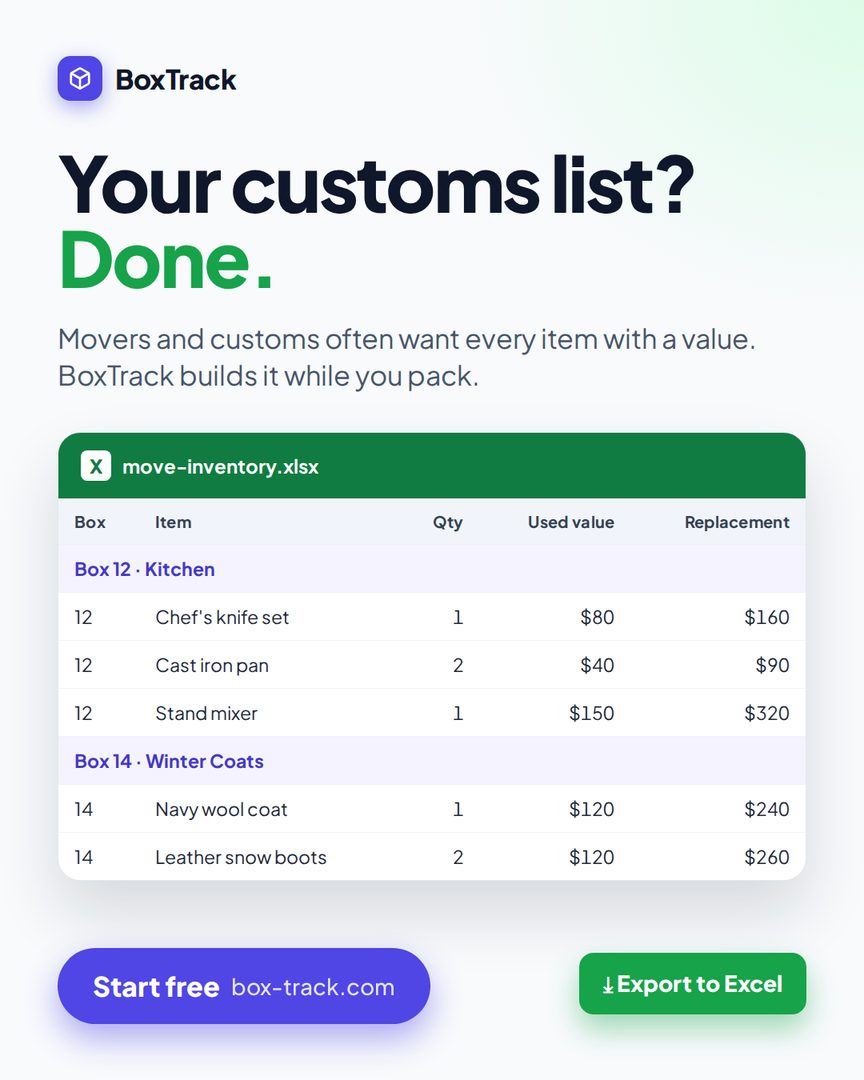
The written list is the one document you create yourself, and it's the one most often thrown together at the last minute. A list that says "Box 14: kitchen" doesn't help anyone tell used goods from new or spot a box that holds medicine.
BoxTrack builds the list as you pack. Make a box in the app for each carton, snap a photo of what goes in, and AI lists the items for you to check, with an estimated value. Print a QR label for every box. When you're done, export the whole list to Excel, with box numbers, items, quantities and values, and use it as the base for the list you give your mover. BoxTrack doesn't file anything with UAE customs or translate the list; it keeps the list you hand over in step with what's actually in the boxes. See how BoxTrack works for customs. Your first box is free.
This is general information, not customs or legal advice. Rules change and can differ between emirates; check with Dubai Customs or the customs authority where your goods will clear, the Ministry of Health and Prevention for medicines, and your moving company.
Sources
- Dubai Customs, Customs duty exemptions
- Dubai Customs, Clearance of personal effects
- Dubai Customs, Customer guide
- Dubai Customs, Prohibited and restricted goods
- Dubai Customs, Passenger customs guide
- UAE Government portal, Customs clearance
- UAE Government portal, Drugs and controlled medicines
- Federal Customs Authority, Travelers guide