Moving to Ireland: transfer of residence relief
How to bring your household goods to Ireland from outside the EU without customs duty or VAT, using form C&E 1076, and the time limits that matter.
 The BoxTrack team · · 6 min read

The container from Boston was due into Dublin Port on a Tuesday. On the Friday before, the shipping agent emailed to ask for "your TOR form and the PBN." Thirty boxes of plates, books, coats and a grandmother's rocking chair were already on the water, and none of it had been declared to anyone in Ireland.
If you're moving to Ireland from outside the European Union, your used household goods can usually come in without customs duty or VAT. Revenue, Ireland's tax and customs agency, calls this transfer of residence (TOR) relief. You claim it on a form called the C&E 1076, and you send it before your things arrive. Here's who qualifies, what Revenue wants to see, and the time limits people miss.
Who qualifies
Revenue's rules for the relief come down to a few conditions:
- You've lived outside the EU for at least 12 months in a row before you move to Ireland. Revenue says you may still qualify if you can show you intended to live abroad for at least 12 months.
- You've owned and used the goods for at least six months at your home abroad. Things bought new just before the move generally don't qualify.
- The goods arrive within the window: from six months before you move to Ireland up to 12 months after.
- You keep them for a year. If you sell, lend, hire out or otherwise dispose of the goods within 12 months, the import charges become payable.
This applies to Irish citizens coming home as much as to anyone else. What counts is where you lived, not your passport.
The numbers to know
Moving from the US, the UK or the EU
From the US, Canada, Australia and anywhere else outside the EU, you use the TOR relief described here.
The UK counts as outside the EU for this. Citizens Information, the Irish government's public information service, says goods shipped from Britain go through the same transfer of residence route as goods from further away. If you're moving from Northern Ireland, ask Revenue which rules apply to you.
Moving from another EU country is simpler. Citizens Information says personal belongings sent from another EU member state generally don't carry extra customs duty or VAT in Ireland, because the tax was paid where the goods were bought. Excise duty can still apply to alcohol and tobacco, and vehicles have their own rules.
What the relief covers, and what it doesn't
| Item | Usually qualifies | Notes |
|---|---|---|
| Furniture, kitchenware, linens, clothes | ✓ | Owned and used for 6 months |
| Books, pictures, personal effects | ✓ | List anything of value |
| Private car | ✓ | Separate VRT rules, below |
| Alcohol and tobacco | ✗ | Not covered by the relief |
| Commercial vehicles | ✗ | Not covered by the relief |
| Goods in trade quantities | ✗ | Revenue may treat them as commercial |
Revenue's guidance says the relief is for personal property, and goods whose quantity or nature suggests a commercial purpose don't qualify.
Sending the C&E 1076
The form is the C&E 1076, "Transfer of Residence, Non-EU country." Revenue and Citizens Information both say to send it about two weeks before your goods arrive. It goes by email to the customs office at the port or airport where your things will land. Your shipping agent can usually tell you which one.
The form asks for:
- Your details, your address abroad and your new address in Ireland
- How and when the goods are arriving
- A list of your personal and household effects, with an estimated current value for anything valuable
- A signed undertaking not to sell, lend, hire out or pledge the goods in Ireland for 12 months without Revenue's written permission
Along with it, Revenue looks for three kinds of proof:
- That you lived abroad. Things like a lease or a sale of your home there, the end of a job, or utility bills and bank statements in your name at your foreign address.
- That you've moved to Ireland. A lease or purchase of a home here, or a job starting here.
- That the goods are yours and used. Receipts or invoices where you have them.
If your goods are coming on a freight ferry from Britain, Citizens Information says you'll need a Pre-Boarding Notification (PBN) ID, which you request from Revenue when you send your TOR form, and give it to the ferry company. On a passenger ferry, you go to customs when you arrive at the port.
Bringing your car
A car is the big exception to "one form covers everything." Vehicle registration tax (VRT) has its own transfer of residence relief, with its own conditions. Revenue says the car must be your personal property and you must have owned and used it for at least six months before the move. Use in Ireland while you were living abroad doesn't count toward that. It has to arrive within 12 months of your move, and the relieved VRT becomes payable if you sell or dispose of the car within 12 months of registering it.
There's also a separate VRT TOR form. Revenue's guidance says that form is for people bringing only a vehicle. If your move includes household goods as well, you can't use it, and the C&E 1076 is the form for the whole move. You still have to register the car in Ireland, and Citizens Information says that must be done within 30 days of bringing it in.
A timeline that works
Moving to Ireland, start to finish
- Three months outCheck you meet the 12-month and 6-month rules
- Two months outGather proof of your home abroad and in Ireland
- Six weeks outBook the shipment; start your goods list
- Packing weekNumber every box; list contents and values as you go
- Two weeks before arrivalEmail the C&E 1076 to the port's customs office
- ArrivalAgent clears the goods; keep copies of everything
- First yearDon't sell or lend relieved goods without permission
If you're shipping in more than one load, such as a few suitcases by air and a container later, keep each shipment inside the 12-month window. Our guide to sea container vs air freight covers how people split a move.
Make the goods list once
The part of the C&E 1076 that takes longest is the list. Customs officers want to know what's in the shipment, and your agent wants box numbers that match what's on the truck. Writing it after the boxes are taped means guessing.
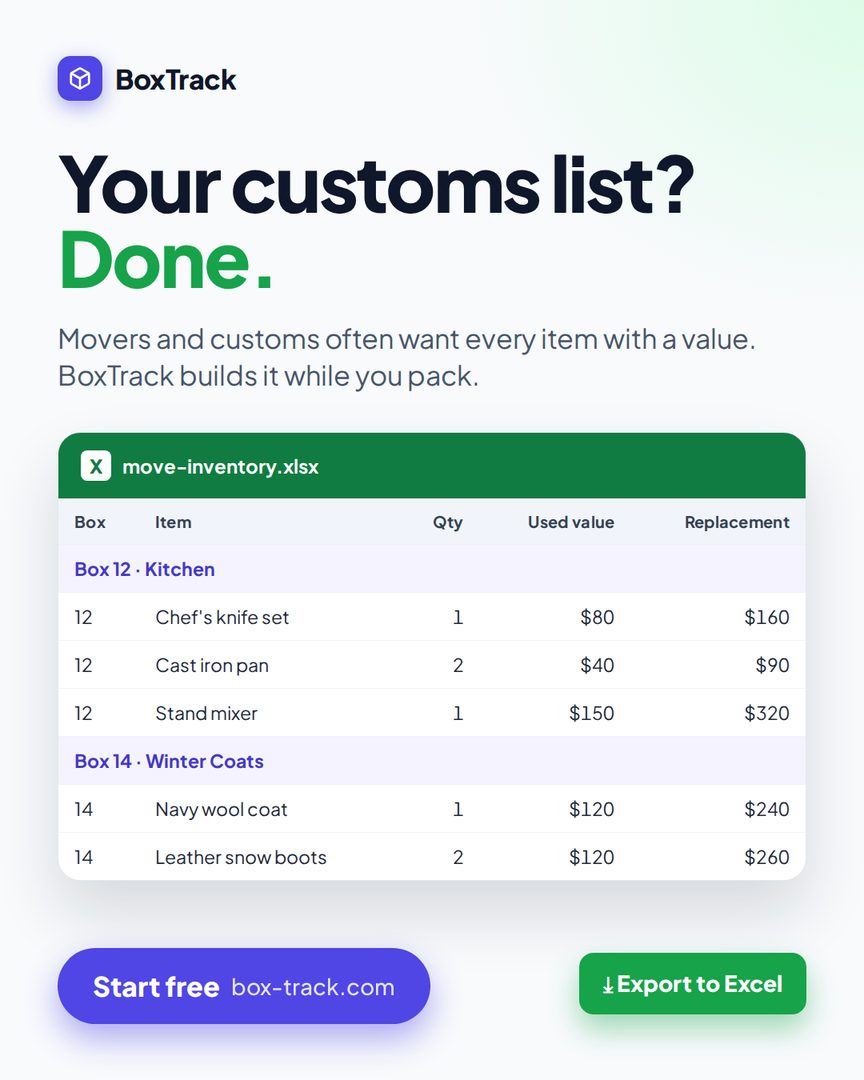
BoxTrack keeps that list as you pack. Make a box in the app for each carton, snap a photo of what goes in, and AI lists the items for you to check, with an estimated value. Print a QR label for every box. When you're done, export everything to Excel: box numbers, items, quantities and values. You can copy that into the form's goods list and send the same file to your agent. It doesn't fill in Revenue's form for you, but it means the list you type in is the one you actually packed. See how BoxTrack works for customs. Your first box is free.
Moving to Britain instead? Our guide to UK transfer of residence relief covers the ToR1.
Sources
- Revenue, What rules apply to the relief?
- Revenue, Procedure at importation
- Revenue, Form C&E 1076, Transfer of Residence, Non-EU country
- Revenue, Permanent relief from payment of import charges
- Revenue, VRT transfer of residence
- Citizens Information, Shipping your personal belongings back to Ireland
- Citizens Information, Bringing your vehicle to Ireland
This is general information, not customs or tax advice. Revenue's rules and forms change, so check the current guidance on revenue.ie or ask Revenue or your shipping agent before you ship.