Moving to the Netherlands with household goods
How to bring your belongings to the Netherlands from outside the EU without import duty, who qualifies, and what Dutch Customs and your mover need from you.
 The BoxTrack team · · 5 min read

The container was booked for Rotterdam. The new job in Utrecht started in five weeks, the apartment lease was signed, and the moving company's agent had sent a short email: "Please send your signed inventory and your municipal registration as soon as you have it." The family had neither. They also hadn't realized they couldn't file anything with Dutch Customs themselves.
If you're moving to the Netherlands from outside the European Union, your used household goods can usually come in without import duties. The rules come from the same EU relief that applies across the bloc, and the Dutch Customs administration (Douane) explains how it works in the Netherlands. The most important difference from some other countries is who files: in the Netherlands, it's your moving company.
Who qualifies
According to Dutch Customs, you can import your household effects without paying import duties if:
- You've lived outside the EU for at least 12 consecutive months.
- You've owned and used the goods for at least six months.
- You'll keep using them for the same purpose in the Netherlands.
- You bring them in within 12 months of taking up residence in the Netherlands.
After the goods arrive, you may not lend, pledge, lease out or transfer them within 12 months of the date they were imported.
The numbers that matter
What doesn't qualify
Dutch Customs lists the exclusions: products containing alcohol, tobacco and tobacco products, commercial vehicles, and non-portable materials for professional use. A private car can come in as part of your household effects, but it needs its own declaration, and the exemption from the Dutch vehicle tax (BPM) is a separate step.
| Item | Usually exempt | Notes |
|---|---|---|
| Furniture, kitchenware, linens | ✓ | Owned and used for 6 months |
| Clothes, books, personal effects | ✓ | On the signed inventory |
| Electronics and appliances | ✓ | List them with enough detail to identify |
| Private car | ✓ | Separate declaration, plus a BPM step |
| Alcohol and tobacco | ✗ | Excluded |
| Commercial vehicles | ✗ | Excluded |
| Non-portable work equipment | ✗ | Excluded |
How the declaration works
Dutch Customs says you can't apply on your own. Your moving company files the declaration through Customs' electronic system, using a special relief code for household effects. What you do is give the mover the documents it needs.
1. A signed inventory
The core document is a signed inventory listing all the personal goods you want to bring to the Netherlands. The moving company uses it to make the declaration, so it needs to be complete and readable. List items box by box, and note anything of value or anything that might raise a question.
2. Proof that you've moved
Customs asks for your certificate of registration in the municipal personal records database (BRP), showing the date you settled in the Netherlands. You get this by registering with the municipality where you'll live.
If you don't have it yet when the goods arrive, Customs accepts proof that you've deregistered from your previous country, plus one supporting document, such as an employment contract, an employer's statement, a work permit or a rental contract. Ask your mover early which of these it wants, since it's the one filing.
3. Anything for the car
If a car is part of the move, your moving company makes a separate customs declaration for it. The import declaration with its exemption code then goes with your application for the BPM exemption. The Netherlands Worldwide car import roadmap walks through the order of the steps.
Students and other cases
Dutch Customs has separate pages for people coming to study, for wedding gifts sent ahead of a marriage, and for inherited goods. If any of those fit you better than a standard move, read that page first, because the conditions are different.
Moving from another EU country is simpler. Dutch Customs says no declaration is needed for goods moving within the EU.
A timeline
Moving to the Netherlands, step by step
- Two to three months outCheck the 12-month and 6-month conditions; pick a mover that handles Dutch customs entries
- Two months outStart the inventory; decide on the car
- Six weeks outAsk your mover which proof of residence it needs
- Packing weekNumber every box and list contents as you pack
- Before shippingSign the inventory and send it to the mover
- On arrivalRegister with your municipality; send the BRP certificate to the mover
- First yearDon't sell, lend or lease relieved goods for 12 months after import
The list is the whole job
Every part of this comes back to the signed inventory. A list made from memory after the boxes are sealed tends to read "kitchen, 8 boxes," and that's not much help to a customs officer or a mover.
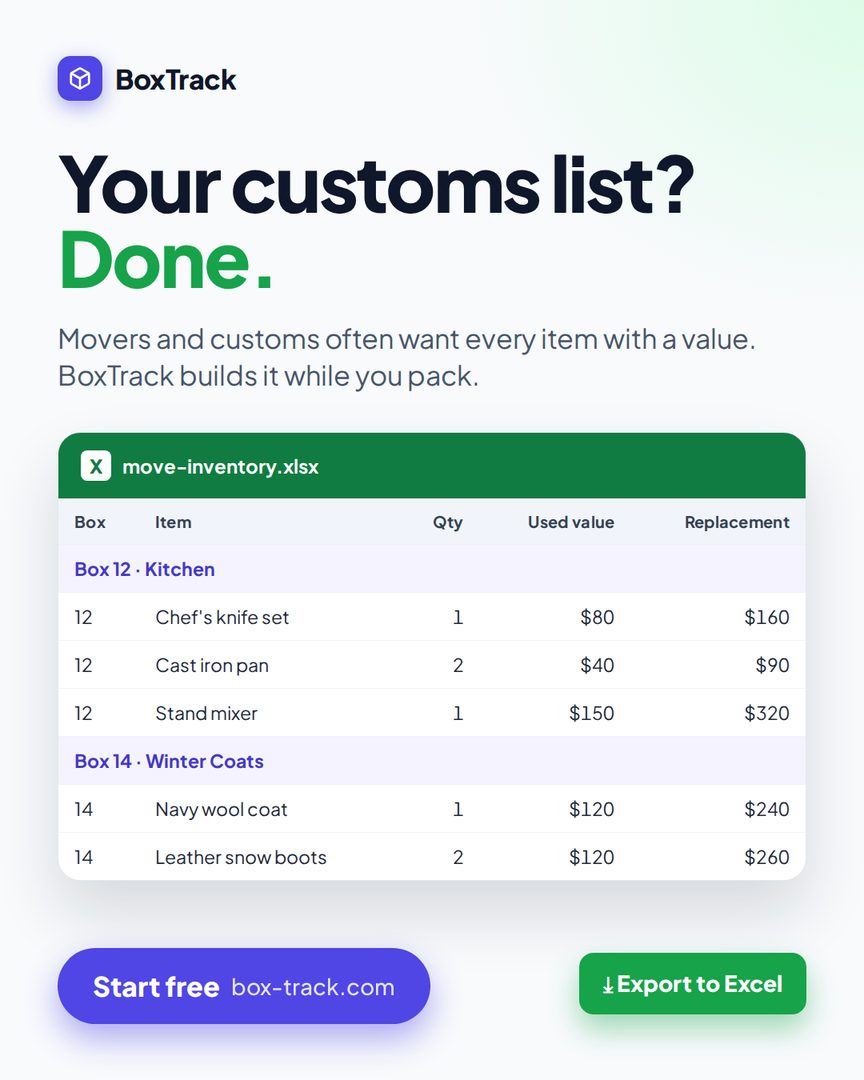
BoxTrack builds the list as you pack. Make a box in the app for each carton, snap a photo of what goes in, and AI lists the items for you to check, with an estimated value. Print a QR label for every box. When you're done, export everything to Excel, with box numbers, items, quantities and values, and use it as the base for the inventory you sign and send to your mover. BoxTrack doesn't file anything with Dutch Customs or translate the list; it means the list you sign matches what you packed. See how BoxTrack works for customs. Your first box is free.
Moving somewhere else in Europe? Our guides to moving to Germany and moving to France cover the same EU relief in those countries.
This is general information, not customs, legal or tax advice. Rules can change, so check with Dutch Customs and your moving company before you ship.
Sources
- Dutch Customs (Douane), Moving to the Netherlands
- Dutch Customs (Douane), Moving things from a non-EU country
- Dutch Customs (Douane), Moving things from an EU country
- Dutch Customs (Douane), Studying in the Netherlands
- Netherlands Worldwide, Step-by-step plan for importing a car into the Netherlands
- EUR-Lex, Council Regulation (EC) No 1186/2009, relief from customs duty