Moving to Italy with household goods: customs relief
How to bring your belongings to Italy from outside the EU without customs duty, who qualifies, and the list and declarations Italian customs asks for.
 The BoxTrack team · · 5 min read

The shipping agent in New Jersey needed two things before the container could be booked to Livorno: a signed list of everything in it, and the date the family had stopped living in the US. The list they had was a page of notes like "kitchen stuff, 6 boxes." The agent sent it back.
If you're moving to Italy from outside the European Union, your used household goods can usually come in without customs duty. The relief comes from an EU regulation that Italy applies through its customs agency, the Agenzia delle Dogane e dei Monopoli (ADM). What changes is the paperwork, which depends on whether you're an Italian citizen coming home or someone moving to Italy for the first time.
Who qualifies
The relief is set out in EU Council Regulation 1186/2009, the same rules every EU country uses for people moving in from outside the EU. ADM's application forms for a transfer of residence ask you to confirm that:
- You've lived outside the EU for at least 12 months in a row.
- You've owned and used the goods for at least six months before you left your old home.
- The goods will be used for the same purpose in Italy.
- You won't lend, pledge, hire out or sell them for 12 months without telling customs.
Under the regulation, the goods are generally declared within 12 months of the date you take up residence in Italy. If they arrive before you've moved your residence, ADM has a separate form for that case, which comes with a guarantee.
The numbers that matter
What isn't covered
The regulation excludes alcohol, tobacco, commercial vehicles and professional equipment other than portable tools of a trade. Goods in quantities that suggest a business don't count as personal property. A private car can qualify if you've owned it for at least six months, but it needs its own documents.
| Item | Usually qualifies | Notes |
|---|---|---|
| Furniture, kitchenware, linens | ✓ | Owned and used for 6 months |
| Clothes, books, personal effects | ✓ | List them, even if low value |
| Electronics | ✓ | Some consulates ask for make, model and serial number |
| Private car | ✓ | Owned at least 6 months; extra documents |
| Alcohol and tobacco | ✗ | Excluded by the regulation |
| Commercial vehicles | ✗ | Excluded by the regulation |
Italian citizens coming home
If you're an Italian citizen registered with AIRE, the register of Italians living abroad, the process usually goes through your consulate's guidance, and it differs from one consulate to another.
The Italian Embassy in Washington says that for household goods alone, the consulate doesn't issue a document. Instead, Italian customs asks for a self-declaration (autocertificazione) giving the date you arrived abroad, the date you're returning, and your next address or at least the municipality, plus a list of your household goods, drawn up and signed by you. The embassy publishes a form for that declaration.
Other consulates do it differently. Some issue a certificate for customs, and the consulate in Manchester, for example, asks for the declaration and three signed copies of the detailed list at least 60 days before your removal. The Sydney consulate asks for make, model and serial numbers for TV and hi-fi equipment. Check the page of the consulate where you're registered before you book the move.
Moving to Italy for the first time
If you're not an Italian citizen, the same EU relief applies, but you show your move with other documents. ADM's transfer-of-residence forms list the kinds of proof it accepts that you lived abroad, such as a statement from a foreign employer, a lease or deed for a home abroad, or a consular certificate, plus a copy of your ID. You'll also need to show your new residence in Italy. Some consulates mention an affidavit, prepared by a local notary or lawyer and legalized by the consulate, as one way for non-EU citizens to support the claim.
Foreign documents may need an Italian translation. Ask your consulate or the customs office at the port of arrival which documents they want, and in what form, before the goods ship. Your moving company's agent in Italy usually handles the customs entry and will tell you what they need from you.
Moving from another EU country is simpler. There's no customs declaration on goods moving between EU member states.
Make the list before you pack, not after
Every route above comes back to one document: a detailed, signed list of what you're bringing. Customs officers and agents want to know what's in the shipment, and your agent wants box numbers that match the truck. A list written after the boxes are taped is mostly guesswork.
Moving to Italy, step by step
- Three months outCheck the 12-month and 6-month rules
- Two months outRead your consulate's page; gather proof of residence
- Six weeks outBook the shipment; start the goods list
- Packing weekNumber every box; list contents as you go
- Before shippingSign the list and declarations; send them to your agent
- ArrivalAgent clears customs; keep copies of everything
- First yearDon't sell or lend relieved goods without telling customs
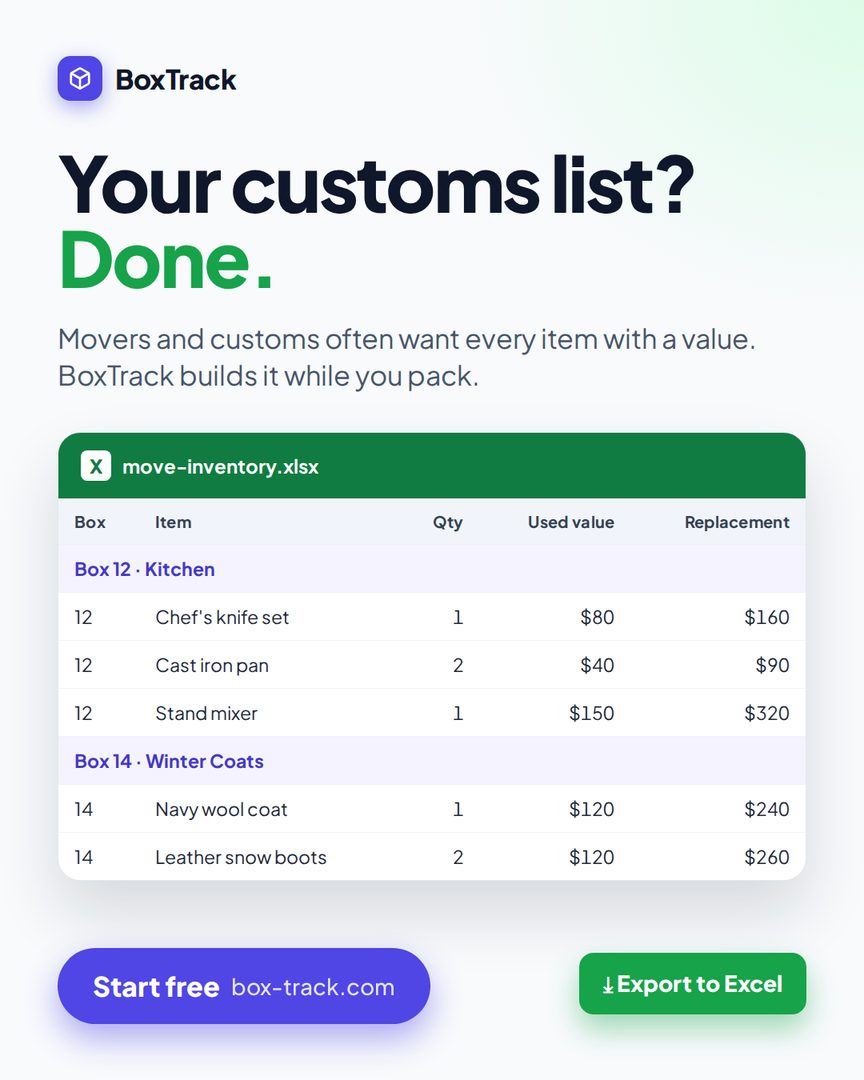
BoxTrack keeps that list as you pack. Make a box in the app for each carton, snap a photo of what goes in, and AI lists the items for you to check, with an estimated value. Print a QR label for every box. When you're done, export everything to Excel, with box numbers, items, quantities and values, and use it as the base for the list you sign and send to your agent. It doesn't fill in Italian customs forms or translate the list, but it means the list you hand over is the one you actually packed. See how BoxTrack works for customs. Your first box is free.
Moving somewhere else in Europe? Our guides to moving to France and moving to Spain cover the same EU relief in those countries.
Sources
- EUR-Lex, Council Regulation (EC) No 1186/2009, relief from customs duty
- Agenzia delle Dogane e dei Monopoli, Franchigie doganali (customs reliefs and forms)
- Agenzia delle Dogane e dei Monopoli, Mod. F-01 B, transfer of residence to Italy with guarantee
- Embassy of Italy in Washington, Permanent return to Italy: customs treatment
- Consulate General of Italy in New York, Importing household goods and vehicles
- Consulate of Italy in Manchester, Certificates issued by the consulate
- Consulate General of Italy in Sydney, Repatriation
- Consulate General of Italy in Toronto, Customs exemption
This is general information, not customs, legal or tax advice. Rules and consulate requirements change, so check with Italian customs, your consulate or your moving agent before you ship.