Moving to the UK: transfer of residence relief
How to bring your household goods into the UK without customs duty or import VAT, what the ToR1 asks for, and the 12-month rules that trip people up.
 The BoxTrack team · · 5 min read

The movers were booked, the container was booked, and the new flat in Bristol had keys waiting. Then the moving company's checklist arrived with one line in bold: "We can't load until you send us your ToR reference number." Nobody had mentioned a ToR. It turned out to be the thing standing between 22 boxes of ordinary household stuff and a customs bill.
If you're moving to the UK to live, your used belongings can usually come in without customs duty or import VAT. That's called transfer of residence relief, or ToR. You apply to HM Revenue and Customs (HMRC) with a form called the ToR1, and you do it before your things are shipped. This guide covers who qualifies, what the form asks for, and the two 12-month rules that matter most.
Who qualifies
The conditions are set out in HMRC's guidance on transfer of residence to the UK. In short:
The three numbers to know
- You've lived outside the UK for at least 12 consecutive months. HMRC can sometimes waive this if you meant to stay abroad that long and something outside your control cut it short.
- You've owned and used the goods for at least 6 months. New things bought just before the move generally don't qualify.
- You'll use them for the same purpose in the UK. Household goods stay household goods.
- They arrive within 12 months of your move. They can come in more than one shipment. HMRC may extend this in exceptional circumstances, but its guidance says not having the money or the space for them doesn't count.
The UK means Great Britain (England, Scotland and Wales) and Northern Ireland, with one difference. GOV.UK says that if you're moving from the EU to Northern Ireland, you don't need to apply for ToR at all.
What it covers, and what it doesn't
| Qualifies for relief | |
|---|---|
| Furniture, linens, kitchenware, clothes | ✓ |
| Bikes, private cars, motorbikes, caravans | ✓ |
| Portable tools you use for your own trade | ✓ |
| Household pets | ✓ |
| Alcohol and tobacco | ✗ |
| Commercial vehicles and non-portable work equipment | ✗ |
| Goods from a second or holiday home | ✗ |
Relief only deals with duty and VAT. Things that need a licence or have their own import rules, such as firearms, certain animal and plant products, or protected species, still need those permissions. Pets have their own entry requirements too, which are separate from ToR.
The ToR1: what it asks for
You apply online through GOV.UK's ToR1 application. The guidance tells you to write a list of everything you're bringing before you start the form, because you'll need it as you go and may be asked to upload it.
The form asks for:
- Proof that you lived outside the UK, and your UK address if you have one
- When you're moving and how your things are coming
- The list of goods
- For vehicles, details like the registration, vehicle identification number and purchase date
Bikes have to be listed but don't need the full vehicle detail.
A good list is grouped and specific: "Box 14, kitchen: 12 plates, 8 bowls, saucepans (4)" says far more than "kitchen items". For anything valuable, add the make, model or serial number. If the list is vague and an officer opens a box that doesn't match, that's when questions start.
The reference number
If HMRC approves the application, you get a unique reference number. That number has to appear on the paperwork that comes with your shipment. Give it to your moving company or customs agent; they put it on the import declaration so the goods clear without charges.
HMRC's guidance is blunt about the alternative. If no valid reference number is quoted, you may be billed for import duties and administration charges. If that happens and relief is approved later, you claim the money back on form C285, which is slower and more paperwork than getting it right the first time.
A UK move with ToR relief
- Before packingWrite the list of everything, box by box, with values for anything expensive
- Before shippingApply on the ToR1 and wait for approval
- ApprovalSend the reference number to your mover or customs agent
- Shipment arrivesGoods clear using the reference number on the import declaration
- The next 12 monthsDon't sell, lend, hire out or give away anything you brought in under relief
The rule after you arrive
Goods brought in under relief can't be lent, used as security, hired out or transferred to another person for 12 months after your move, according to HMRC. Selling the sofa you shipped over because it doesn't fit the new flat counts. If you do, the duty and VAT you were excused can become payable.
So if you suspect something won't suit the UK home, it's often simpler to sell it before you go than to ship it and be stuck with it for a year.
Special cases
- Students coming for full-time study don't use the ToR1. They declare their goods with proof of their course instead.
- People getting married or entering a civil partnership in the UK have a separate relief for wedding gifts and household goods, with its own timing.
- UK citizens coming home use the same ToR relief as anyone else, as long as they meet the 12-month residence rule.
Make the list once
The list is the heart of a ToR claim, and it's also what your mover needs and what your insurer will ask for if something is damaged at sea. Writing it once and using it three times saves hours.
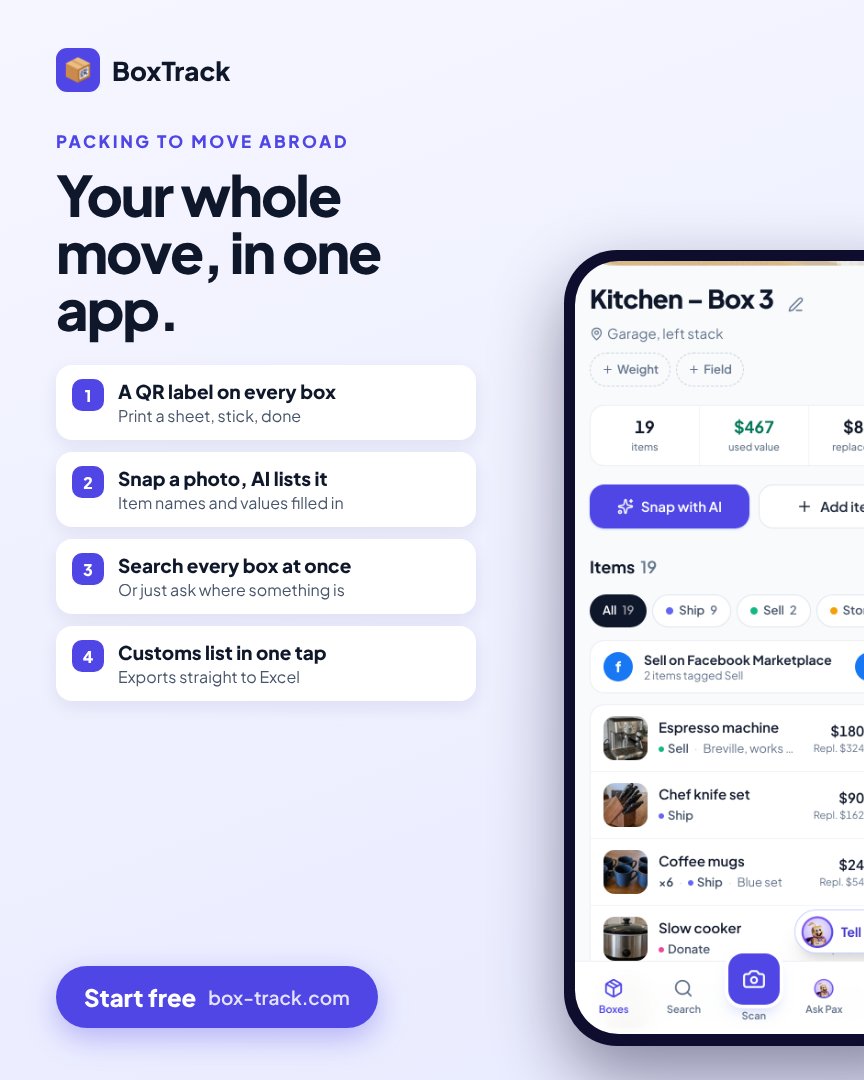
BoxTrack does that from your phone. Make a box in the app for each carton, snap what goes in, and AI lists the items with an estimated value for you to check. Print a QR label for each box. When you're done, export the whole list to Excel with box numbers, items, quantities and values, ready to upload to the ToR1 or send to your mover. See how BoxTrack handles customs lists. Your first box is free.
If you're still deciding how to ship, container vs air freight compares the two. For a general list of what to declare and what to leave behind, see our moving abroad packing list for customs, or start from the free customs list template.
Sources
- HM Revenue and Customs, Transfer of residence to the UK
- HM Revenue and Customs, Application for transfer of residence relief (ToR1)
- GOV.UK, Moving personal belongings to the UK
This is general information, not legal or customs advice. HMRC decides every claim, and the rules can change. Check the current GOV.UK guidance, or ask your mover's customs agent, before you ship.