Moving to Switzerland: form 18.44 and your goods
How household goods clear Swiss customs duty-free with form 18.44, the six-month rule, the papers to bring and what gets taxed instead.
 The BoxTrack team · · 6 min read
The truck stopped at the border crossing near Basel at ten in the morning. The driver had the passports, the lease for the apartment in Zurich and a two-page form. What he didn't have was the separate list of what was in the truck. The family had written "household goods, 38 boxes" on the form and assumed that would do.
It didn't, and the next few hours went to rebuilding a list from memory on a laptop in the cab. Swiss customs is generous to people moving in, but the generosity runs on paperwork, and the paperwork is mostly a list you write yourself.
The short version: used goods come in duty-free
Switzerland's Federal Office for Customs and Border Security (BAZG) lets people moving their residence to Switzerland bring their household effects in free of duty and tax, as long as a few conditions hold. The one that matters most: you must have used the items personally for at least six months, and you must keep using them in Switzerland. The Swiss government portal ch.ch gives the same rule.
That rule decides most of what happens at the border. A sofa you've had for three years qualifies. A sofa you bought last month to ship over does not.
Swiss removal goods in brief
What form 18.44 is
Form 18.44 is the application for duty-free clearance of household effects. BAZG says you present the completed form to the customs office where the goods enter Switzerland. It doubles as your written customs declaration at the border, so what's on it, and on the list attached to it, is what you are declaring.
Your moving company will usually handle the clearance, but the form and the list are still yours to get right. You know what's in the boxes; they don't.
The papers to bring
ch.ch lists what you'll need at the customs office:
- A full list of the goods, on a separate sheet
- Form 18.44, filled in, in two copies
- An identity document
- Proof that you told your old country you're leaving, such as a departure notice
- A Swiss residence permit, or other proof you're moving your home there, such as an employment contract or a lease
The residence permit isn't always ready in time. BAZG's FAQ says a permit isn't an absolute requirement, and that your declaration of departure from the other country, together with an employment contract and a lease, can serve as proof instead. Ask your mover what they'll need from you if the permit is still being processed.
How to write the list
BAZG says household effects are declared on an inventory list, and that bulky or valuable items, such as furniture, objects of value and big appliances, need to be listed individually and in detail. So do restricted items, and BAZG names alcoholic beverages and weapons as examples.
A list that says "Box 12: kitchen" leaves a customs officer nothing to check. A list that says "Box 12: 8 plates, 6 glasses, stand mixer (2019), knife block" does. The more detail on the valuable and restricted items, the less there is to sort out at the border.
| Item | Usually duty-free as removal goods | Notes |
|---|---|---|
| Furniture used for years | ✓ | List each piece |
| Clothes, books, kitchenware in use | ✓ | List by box |
| Appliances and electronics you own and use | ✓ | List each one, with detail |
| Things bought less than six months ago | ✗ | BAZG says to list them as goods to be taxed |
| New items still in the box | ✗ | They haven't been used |
| Alcohol and weapons | ✗ | Restricted; list individually and check rules first |
What gets taxed instead
Things that don't meet the conditions aren't banned. BAZG's FAQ says items such as a purchase made less than six months before the move should be listed as goods to be taxed. Switzerland's standard import VAT rate is 8.1 percent, with a reduced 2.6 percent rate for some categories such as food, books and medicines, according to BAZG and the Federal Tax Administration. Customs duty may apply too, depending on the item.
That's worth knowing before you shop. New furniture bought just before the move and shipped over can come with VAT and duty at the border, on top of what you paid for it.
Cars and other vehicles
A car can come in as household effects, but it has its own rules. BAZG says the vehicle must be cleared the first time it crosses into Switzerland, and it must be there during clearance. Whether it comes in duty- and tax-free depends on conditions such as how long you've used it abroad, so read BAZG's vehicle relocation page before you decide whether to ship it, sell it or drive it in.
When the goods arrive
Household goods are cleared during the opening hours of customs offices that handle commercial goods, generally on weekdays, according to BAZG. Only some larger offices offer Saturday morning service. If the truck is due at the border at the end of a week, check which office it will use and when that office is open.
Moving to Switzerland, step by step
- Three months outGet mover quotes and ask how they handle Swiss clearance
- Two months outStart the box-by-box list; note anything bought in the last six months
- Six weeks outDecide about the car; read BAZG's vehicle page
- Packing weekNumber every box and list what's in it as you pack
- Before the truck leavesFill in form 18.44 twice; gather ID, lease, job contract, permit
- Border dayCustoms office checks the form and the list
- On deliveryCheck boxes off the list as they come in
For more on choosing between sea and air for an overseas move, see our guide to container vs air freight, and our customs packing list guide covers how to write a list any customs office can read.
Make the list while you pack
The separate list of goods is the document that slows people down, and it's easiest to write while the boxes are still open.
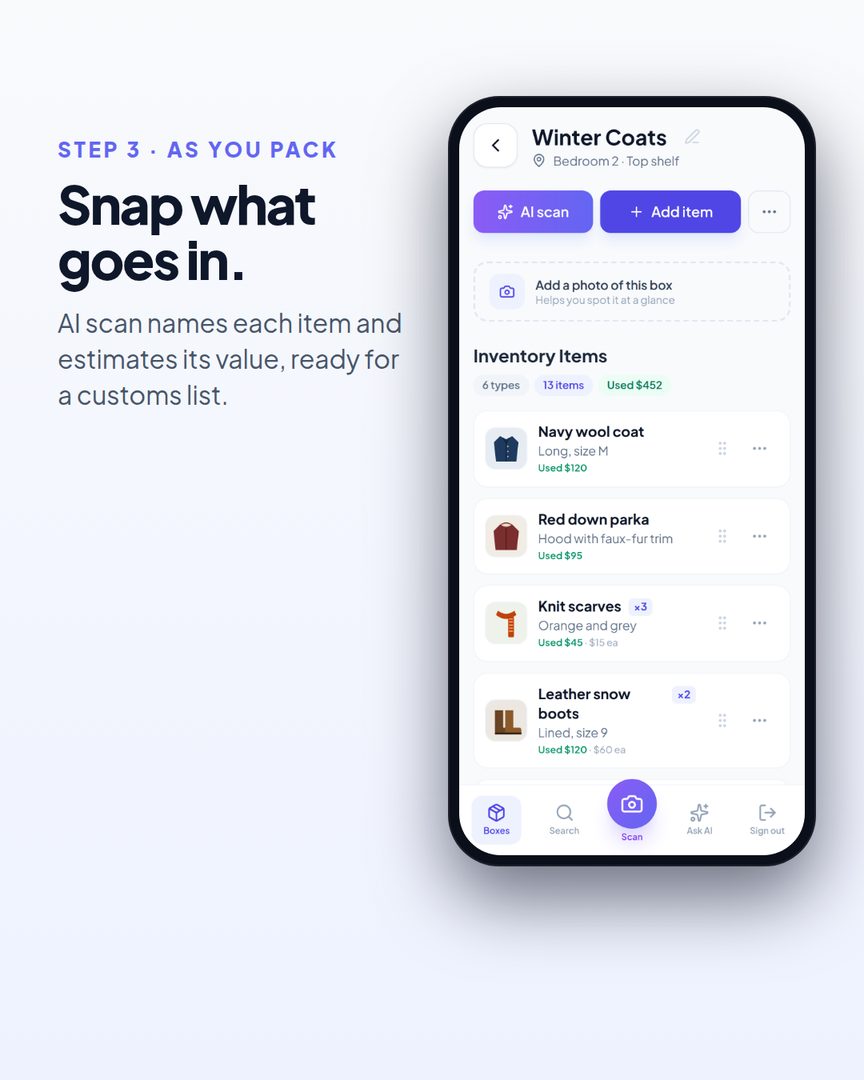
BoxTrack builds it as you go. Make a box in the app for each carton, snap a photo of what goes in, and AI lists the items for you to check, with an estimated value. Print a QR label for every box. When you're done, export the list to Excel, with box numbers, items and quantities, and use it as the base for the list you attach to form 18.44. BoxTrack doesn't fill in form 18.44 or file anything with Swiss customs, and it doesn't translate; it keeps your list in step with what's actually in the boxes. See how BoxTrack works for customs. Your first box is free.
This is general information, not customs or legal advice. Rules change; check with the Federal Office for Customs and Border Security (BAZG) and your moving company before you ship.
Sources
- BAZG, Moving (household effects)
- BAZG, Moving to Switzerland: procedure
- BAZG, FAQ removal goods
- BAZG, Relocation: vehicles
- BAZG, Import tax: taxable objects and tax rates
- Federal Tax Administration, VAT rates
- ch.ch, Moving to Switzerland