How to pack books for moving without breaking them or you
Small boxes, the right way to stand books in them, what to do with old or valuable ones, and how to keep track of 20 boxes that all look alike.
 The BoxTrack team · · 4 min read
The first box of books went in fine. It was a big one, the kind that held the bedding last time, and it took a whole shelf of hardcovers. Then two people tried to lift it, the bottom split, and a cookbook collection slid across the hallway. Books are the classic packing mistake because they look small and weigh a lot.
Packing books for a move comes down to three things: small boxes, the right position in the box, and knowing which box has which books when you get there.
Use small boxes, and only small boxes
A box full of books gets heavy fast. U-Haul's small moving box, about 1.5 cubic feet, is rated to hold up to 65 pounds, and its book box has the same limit. A box of hardcovers can get close to that well before it looks full.
The rating is what the box can hold, not what's comfortable to carry. Most people do better stopping well short of it, especially on stairs. If you can't lift a box easily on your own, take a few books out.
Never put books in a large box. If you have big boxes left over, use them for pillows, lampshades and towels instead.
How to pack books in the box
The Library of Congress gives simple packing guidance for books, and it works for a move too:
- Tape the bottom well. Run tape along the center seam and across both edges. A heavy box fails at the bottom first.
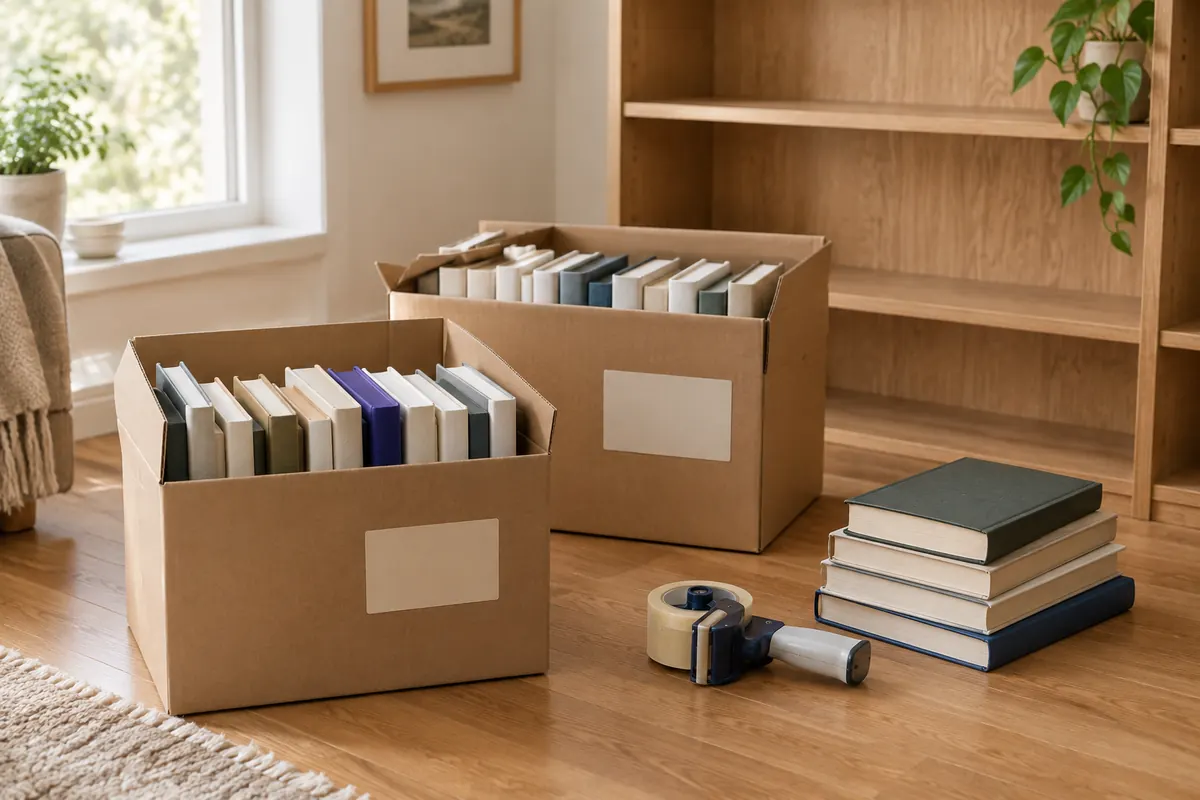
- Lay them flat, or stand them spine down. Flat stacks with the biggest, heaviest books at the bottom are the safest. Standing books upright on their spines also works. Don't stand them with the spine up, since that pulls the pages away from the cover over time.
- Don't lay them on the front edge. A book resting on its page edges, spine up, has the same problem.
- Fill the gaps. Crumpled paper or a towel stops books from sliding and rubbing. A box that shifts when you shake it will shift on the truck too.
- Don't overpack. The lid should close flat without bulging. A bulging lid crushes whatever is stacked on top.
Mix in a few paperbacks to fill space around hardcovers. They're light and fit into gaps.
Old, rare or valuable books
For books you'd be upset to lose, take a little more care.
- Wrap each one in clean paper or a soft cloth. Skip newsprint, since the ink can rub off.
- Pack them in their own box and carry it yourself if you can.
- Don't put them in a hot car or truck for days. The Library of Congress suggests a cool, fairly dry spot for books: 70°F or below and 30 to 55% relative humidity. Heat and damp are what cause warping and mold.
- Photograph valuable books, with the title page, before you pack them. If anything goes missing, you'll have a record.
If they're going into storage
Books stored for months need a dry space. The Library of Congress names basements, attics and garages as poor choices for books, and points out that plastic bins keep out water but don't protect against heat and humidity swings. It suggests acid-free, lignin-free boxes for long-term storage. If you're weighing a climate-controlled unit, our post on climate-controlled storage covers what really needs it.
If books do get wet on the way, the Library of Congress says to air-dry them right away. Books that can't be dried within about two days can be frozen until you're ready to deal with them, which stops mold from growing.
Sort before you pack
Books are heavy, and many movers price by weight, so every book you don't move saves a little effort or money. Go shelf by shelf and pull the ones you won't read again. Libraries, schools and charity shops often take donations, and used bookstores sometimes buy them.
Packing a home library over a weekend
- FridaySort shelf by shelf: keep, sell, donate
- Saturday morningBuild small boxes and tape the bottoms twice
- Saturday afternoonPack the shelves you use least first
- SundayPack the rest, number each box and list what's in it
- Moving dayLoad book boxes first and low, never on top of lighter boxes
Know which box has which books
Twenty small boxes of books all look the same. If you'd like to find your cookbooks before Christmas, a label that just says "books" won't help.

Give each box a number and the room it's going to ("Box 9, office"), and keep a list of what went into it. Our guide on how to label moving boxes walks through a system that works.
BoxTrack makes that list from a photo. Make a box in the app, snap the books as they go in, and AI lists the titles it can see for you to check. Print a QR label for the side of the box. When you're unpacking, search "cookbooks" and BoxTrack tells you it's box 9. See how BoxTrack works for a move. Your first box is free.
Sources
- U-Haul, Small moving box, Book box and Heavy-duty small box
- Library of Congress, Preserving your books: storing
- Library of Congress, Books FAQ