How many moving boxes do you need? Count by room
A room-by-room way to work out how many moving boxes you need, which sizes, and how much tape, before you buy or start collecting.
 The BoxTrack team · · 5 min read
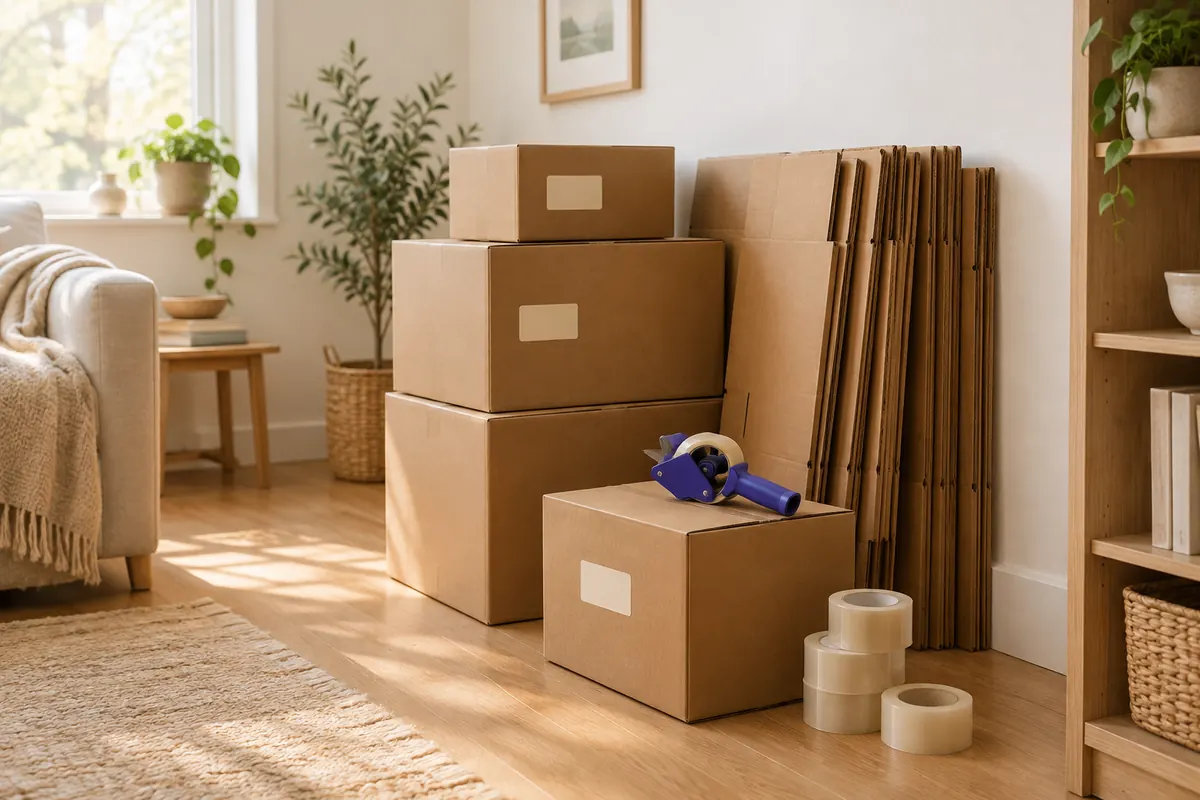
It's the Thursday before the move. The kitchen is done, the living room is half done, and the last flattened box just went into the bookshelf. There are still two bedrooms, a hall closet and everything under the bathroom sink. The hardware store closes at nine.
Running out of boxes is one of the most common ways a move falls behind, and it's avoidable. You don't need an exact number. You need a good estimate by size, made before you start, so you buy once (or collect once) and keep packing.
Why the count by room works better than a guess
The usual guesses go by home size: "a two-bedroom needs about 40." That's a fair starting point, but it hides two things that change the number a lot:
- What's in the rooms. A two-bedroom with a home office, a closet full of craft supplies and three bookcases needs far more than one that was cleared out last spring.
- The mix of sizes. Forty large boxes and forty small boxes are different moves. Heavy things need small boxes, so a book collection adds boxes faster than a closet of coats does.
Counting room by room fixes both. You look at each room once, think about what's in it, and write down how many of each size.
A quick count you can do in ten minutes
Walk through the home with a notepad or your phone. For each room, count:
- Small boxes for anything heavy: books, files, tools, canned food, records.
- Medium boxes for most things: pots and pans, toys, shoes, small appliances, decor.
- Large boxes for light, bulky things: bedding, pillows, towels, lampshades.
- Wardrobe boxes for clothes that stay on hangers.
- Dish packs for plates and glasses, if you're packing the kitchen yourself.
Open the cupboards and closets while you count. The number of things in a kitchen is always bigger than it looks from the doorway. Then add the rooms people forget: the hall closet, the space under the bed, the garage shelves, the attic, the shed.
When you're done, add 10 to 15 percent. U-Haul's own moving advice is that it's better to over-estimate and return what you don't use than to run short in the middle of packing. Unused boxes also make good storage for the first few months in the new place.
What the free box calculator gives for common homes
If you'd rather not count by hand, our free moving box calculator does the room-by-room count for you. You pick the bedrooms, bathrooms and extra rooms, and how full the home is, and it gives a list by size, plus tape and labels. Here's what it suggests for a few homes with an average amount of stuff:
What the calculator suggests (average amount of stuff)
Those numbers move a lot with how full the home is. The same three-bedroom house with a garage comes out at 96 boxes when it's set to "a lot" of stuff. U-Haul's own guidance for a three- to four-bedroom house says such a home may need more than 100 boxes of various sizes, and its kit for that size of home has 104 pieces. Treat any number as a starting point and adjust after your walk-through.
For a two-bedroom apartment, the calculator splits the 41 boxes roughly like this:
| Room | Boxes | Mostly |
|---|---|---|
| Kitchen | 12 | Small and medium, plus dish packs |
| Main bedroom | 10 | Medium, large and wardrobe boxes |
| Living room | 8 | Medium and large |
| Second bedroom | 8 | Medium and large |
| Bathroom | 3 | Small and medium |
The kitchen almost always comes first. It has the most small, heavy, breakable things in the home, and it takes more boxes than people expect.
Tape, labels and the other supplies
Boxes are only part of the shopping list. Plan for:
- Tape. The calculator assumes one roll seals about 15 boxes, with strips across the bottom and the top. A 41-box move needs about three rolls. Buy one more than you think, since a roll always disappears on moving day.
- Labels. Two per box, on two sides, so you can read them when boxes are stacked. More on that in our guide to labeling moving boxes.
- Packing paper. For the kitchen especially. Plates and glasses each get wrapped.
- Markers. More than one. They walk away.
If movers are packing for you
When a moving company packs, they bring their own boxes and charge for them. For an interstate move, the FMCSA says movers must give you a written estimate, and packing is one of the services that belongs on it. If the estimate is non-binding, the final bill is worked out from the mover's tariff, and the mover can't require you to pay more than 110 percent of the estimate at delivery. Ask for the parts of the tariff that cover packing before you choose a mover. Our guide to reading a moving estimate goes through the lines to look for.
If you pack the boxes yourself and hand them to the movers, the FMCSA notes that it can be harder to make a damage claim for things you packed, so use sturdy boxes and pack them well.
Keep the count going while you pack
The count you made before packing is an estimate. The count you keep while packing is your inventory. Number each box as you tape it, and you'll always know how many are done and how many rooms are left.
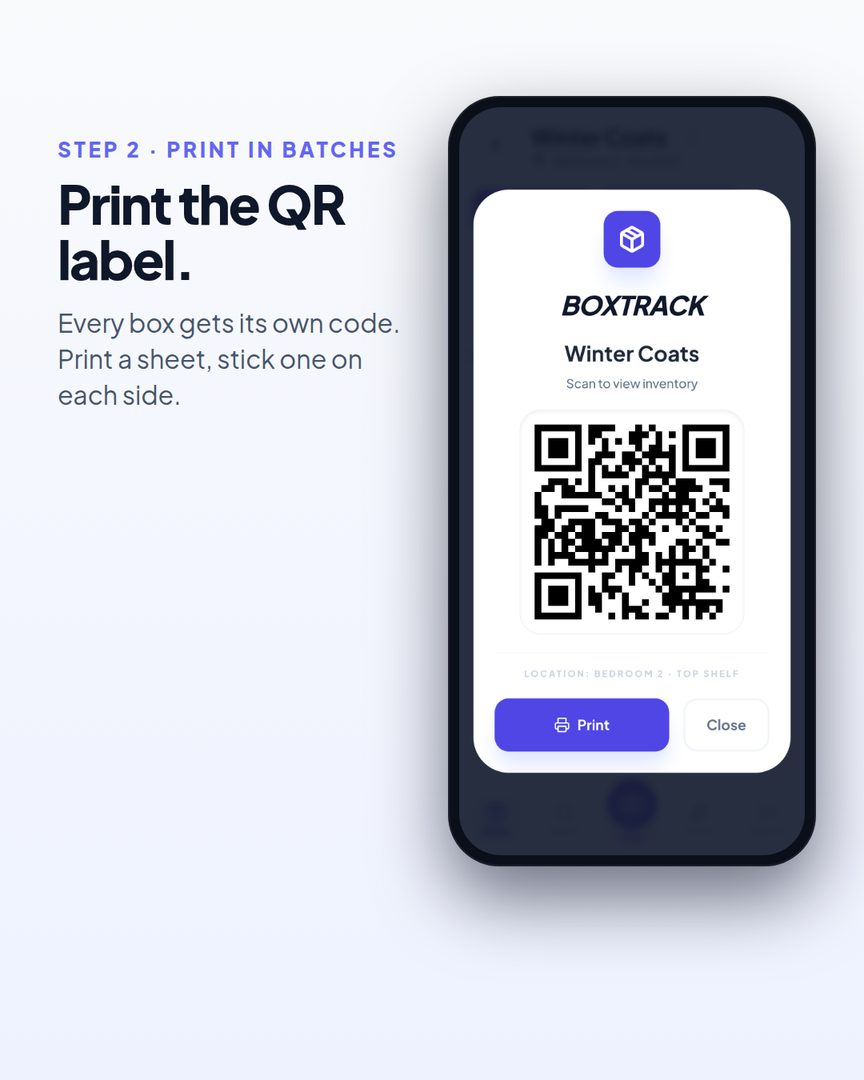
BoxTrack does that part for you. Make a box in the app, snap a photo of what's going in, and AI lists the items for you to check. Each box gets a numbered QR label to print, so the box count and the list are the same thing. On moving day, you can count boxes off the truck and scan any one of them to see what's inside. See how BoxTrack works for a move. Your first box is free.
Once you know how many boxes you need, the next question is which size goes where. Our guide to moving box sizes covers that.
Sources
- U-Haul, How many boxes do I need to move?
- U-Haul, 104-piece moving box kit for 3-4 bedrooms
- FMCSA, Estimating charges (Subpart D)
- FMCSA, Your rights and responsibilities when you move
- BoxTrack, Moving box calculator